Origins & History
Ten thousand
years of fire
Archaeological evidence places the earliest cultivation of Capsicum annuum in central Mexico and the Tehuacan Valley, with domestication beginning roughly 10,000 years ago. Wild progenitors — small-fruited, intensely pungent ancestors — grew across a vast swathe of tropical and subtropical America.
"No other spice plant has been adopted by so many cuisines, on so many continents, in so short a time."
Christopher Columbus encountered chillies in the Caribbean in 1493 and returned them to Spain. Within 50 years, Portuguese traders had dispersed C. annuum throughout Africa, India, and South-East Asia — an agricultural diffusion without precedent in human history.
BCE
Wild AncestorFirst evidence of C. annuum use in Mexico. Small, hot-fruited wild plants gathered for food.
BCE
DomesticationArchaeological residue at Tehuacan Valley confirms intentional cultivation and selective breeding for larger fruit.
Columbus ReturnsChillies reach Europe. Confused with black pepper, they are named "pepper" — a misnomer that persists today.
Global SpreadPortuguese traders carry seeds to India, Africa, and Asia. Local cultivation explodes within decades.
Linnaeus DescribesCarl Linnaeus formally describes Capsicum annuum in Species Plantarum, establishing the binomial nomenclature used today.
Scoville ScaleWilbur Scoville devises his organoleptic scale, giving C. annuum varieties their first systematic heat measurement.
Morphology
Form & structure
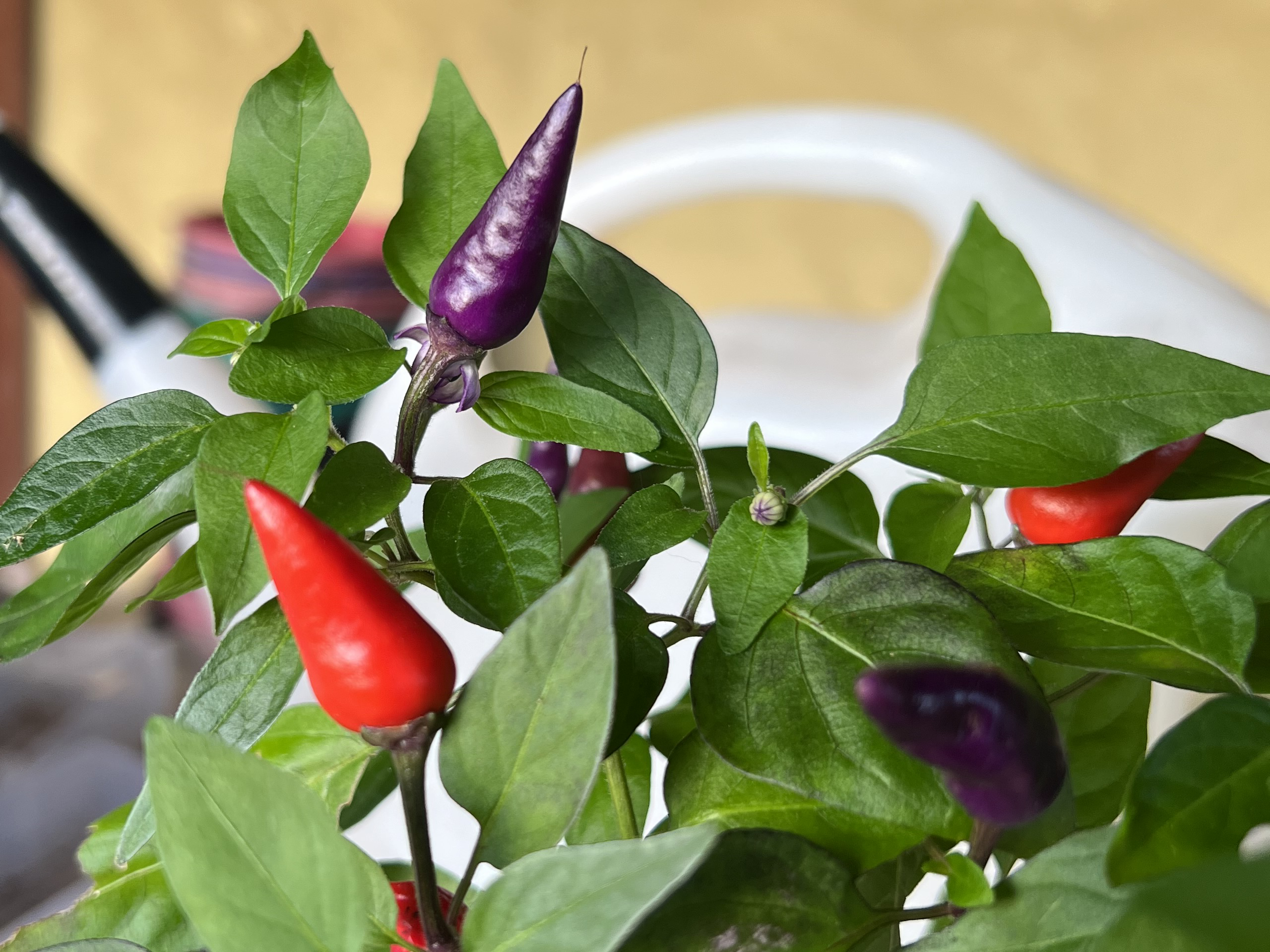
Capsicum annuum is technically a perennial but typically grown as an annual in temperate climates. The species shows remarkable morphological diversity — plants range from compact 30 cm pot specimens to sprawling 1.5 m field varieties, with fruit forms spanning spherical, elongated, blocky, conical, and wrinkled.
Plant
30–150 cm tall. Erect to spreading habit. Stems woody at base when mature. Leaves simple, ovate, 4–12 cm, smooth to slightly pubescent. Perennial in frost-free climates.
Flowers
White to pale violet, solitary or in pairs at stem nodes. Five petals, reflexed. Anthers typically purple. Self-pollinating but highly attractive to bees.
Fruit
Technically a berry. Ranges 1–30 cm in length. Colour progression typically green→yellow→red, though purple, orange, chocolate, and white variants exist.
Capsaicin
Produced in placental tissue, not the flesh or seeds. Binds TRPV1 receptors, producing heat sensation. Varies from 0 ppm in sweet varieties to ~3,000 ppm in the hottest annuums.
Seeds
Flat, disc-shaped, 3–5 mm diameter. Pale yellow to cream. 10–80 seeds per fruit. Seeds remain viable 2–4 years when stored cool and dry.
Chromosomes
2n = 24. Diploid species. Freely crosses with C. chinense, C. frutescens, and C. chacoense — producing fertile hybrids exploited in breeding programmes globally.
Notable Cultivar Groups
A species of
extraordinary range
No other pepper species encompasses such extremes — from zero-heat ornamentals to searing varieties that rival C. chinense.
5,000+
named cultivars worldwide
Sweet / Bell
Bell Pepper
Bred entirely without capsaicin. The world's most commercially produced capsicum.
Mild
Banana Pepper
Pale yellow, elongated, mild and slightly tangy. A pickling staple across the Mediterranean.
Mild–Medium
Poblano
Dark green, heart-shaped. Essential for chiles rellenos and mole negro. Dried it becomes the ancho.
Medium
Jalapeño
Perhaps the most globally recognised chilli. Smoked and dried it becomes chipotle.
Medium–Hot
Serrano
Smaller and considerably hotter than the jalapeño. A cornerstone of Mexican table salsas.
Hot
Cayenne
Long, slender, deeply red when ripe. One of the most traded spices on the planet.
Hot
de Árbol
Slender, tree-like plant with thin-walled pods. Retains bright red colour and sharp, clean heat when dried.
Very Hot
Pequin
Tiny, oval, wild-type pods. One of the hottest annuums. Dispersed naturally by birds.
Culinary & Cultural Use
The most eaten
spice on Earth
By some estimates, over 2 billion people consume Capsicum annuum in some form every single day. No other spice plant comes close. The species underpins the flavour identity of Mexican, Indian, Chinese, Korean, Hungarian, Spanish, and Turkish cuisines — among dozens of others.
The fruit is consumed fresh, dried, smoked, pickled, fermented, and powdered. The capsaicin it contains triggers endorphin release — the "chilli high" — which may partly explain the near-universal human adoption of a plant that initially causes pain.
Key Cuisines
Cultivation
Growing
C. annuum
One of the most adaptable food plants in existence. Capsicum annuum can be grown from seed to harvest in under 90 days in warm conditions, or stretched to perennial cropping in tropical climates. It thrives in containers, raised beds, and open field production alike.
Start seeds indoors 8–10 weeks before last frost. Peppers need warm, consistent temperatures to germinate reliably.
Heat is essential. Soil temperature below 16°C stops root development. Use black plastic mulch in cool climates.
Consistent moisture prevents blossom end rot and cracked fruit. Drip irrigation outperforms overhead watering.
Stress increases capsaicin. Withholding water during final ripening significantly elevates heat in pungent varieties.
Isolation prevents crossing. Sweet and hot varieties cross-pollinate freely within 400 m — important for seed saving.
Growing Parameters
Germination Temp
24–29°C
Days to Germinate
7–21days
Days to Maturity
60–150days
Optimal Soil pH
6.0–6.8
Plant Spacing
45–60cm
Full Sun
6–8hrs/day
Seed Viability
2–4years
Hardiness
Frost sensitive
Taxonomy
Classification &
nomenclature
Described by Carl Linnaeus in 1753 in Species Plantarum, Capsicum annuum is the type species of the genus. The epithet annuum — meaning "annual" — is botanically misleading, as the plant is a true perennial in warm climates.
"The epithet annuum tells us more about European growing conditions than about the plant itself."
Selected Synonyms
Capsicum grossum Willd.
Capsicum longum DC.
Capsicum minimum Mill.
Capsicum cerasiforme Mill.
Capsicum conicum G.Mey.
Full Classification
Related Cultivated Species