Overview
Capsicum coccineum is a wild species of pepper native to Peru, Bolivia and western Brazil. It belongs to the nightshade family, Solanaceae, and is recognised as an accepted species by the Royal Botanic Gardens, Kew. Unlike the compact form of a cultivated chilli, it grows as a sprawling shrub or vine-like plant that uses neighbouring branches and trunks for support.
It is especially distinctive for its crowded flower clusters, sometimes carrying nearly 18 flowers on a short axis, and for the calyx that bends sharply backwards as the fruit develops. The berries are small, round, red and pungent. These traits make the species notable even among the exceptionally diverse wild members of Capsicum.
- Scientific name
- Capsicum coccineum (Rusby) Hunz.
- Family
- Solanaceae
- Native range
- Peru, Bolivia, western Brazil
- Growth habit
- Scrambling shrub or liana
- Original species name
- 1912, Brachistus coccineus
- Current combination
- 1956
- Flowers
- Yellow to cream, sometimes spotted
- Mature fruit
- Small, rounded, red
Discovery & naming
The botanical story begins in 1901, when the collector R. S. Williams gathered a specimen near San Buenaventura, La Paz, Bolivia, on 18 November. Henry Hurd Rusby formally described the plant in 1912 as Brachistus coccineus, placing it in a different genus from chilli peppers.
The species was later transferred to Lycianthes as Lycianthes coccinea in 1926. Argentinian botanist Armando Theodoro Hunziker eventually placed it in Capsicum, publishing the combination Capsicum coccineum in 1956 (in proceedings of the 1954 International Botanical Congress). The name coccineum refers to a scarlet or red colour, fitting its mature berries.
That naming history is a good example of how identifying wild peppers can be less straightforward than identifying familiar cultivated varieties. Flower structure, the calyx, fruit and comparison with related genera all matter when botanists decide where a wild plant belongs.
Growth & foliage
The most striking feature of C. coccineum is its habit. It forms long, flexible and easily broken branches that lean on other plants rather than standing in a self-supporting bush. The 2022 monograph describes stems reaching around 7 metres in favourable forest conditions. It is best thought of as a scrambling plant rather than a twining climber with specialised tendrils.
Older growth becomes woody near its base. The foliage consists of thin, green leaves with pointed tips and generally smooth margins. As in many peppers, leaf pairs can differ in size, while stems branch in a slightly zigzag pattern. Plants may spread through surrounding shrubs at forest edges and along streams.
The unusual growth form is not simply an enlarged version of a domestic pepper plant. It is an adaptation to the forest environment, where supporting vegetation helps long branches gain access to light.
Flowers & identification
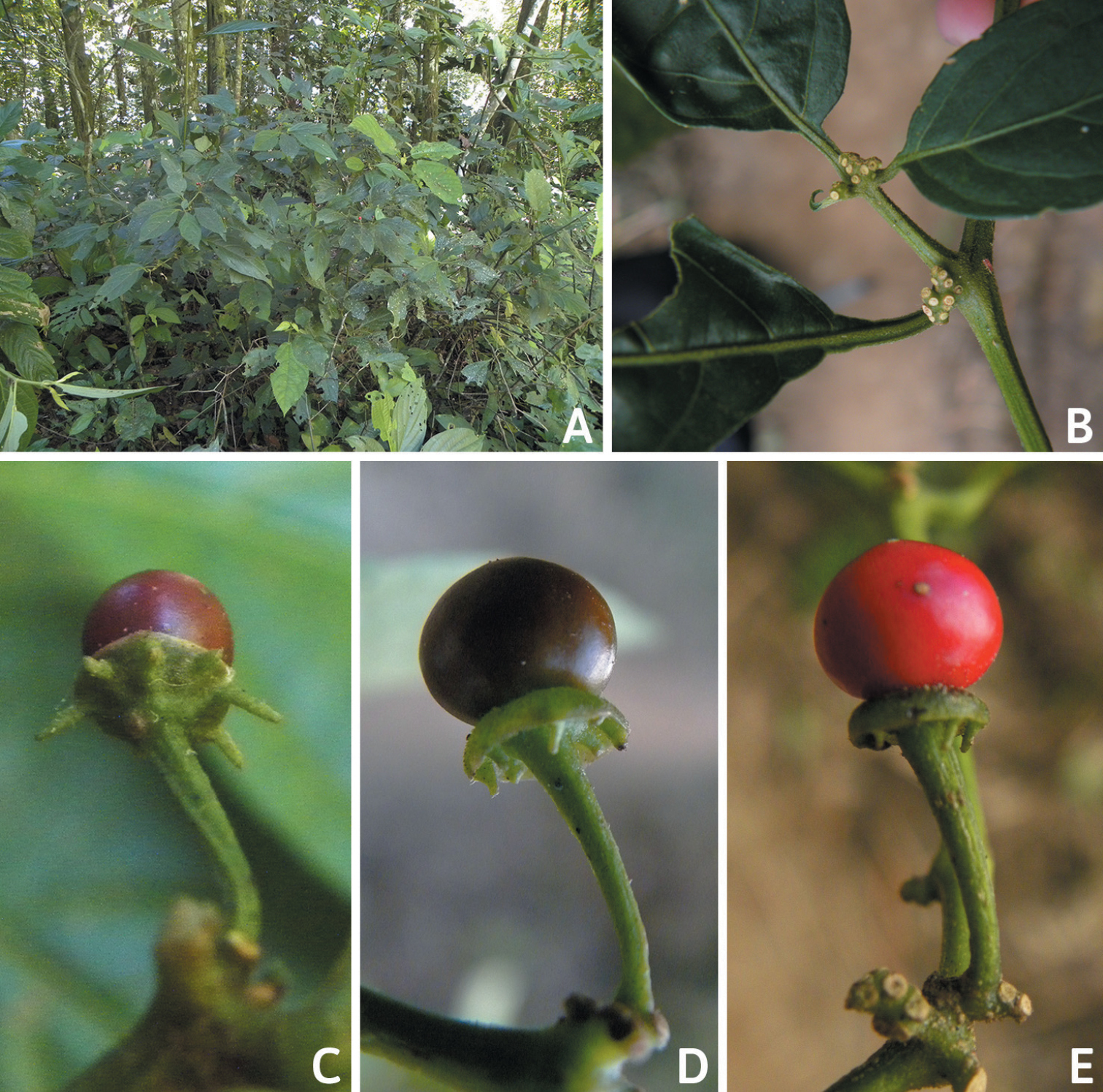
Flowers are borne in crowded groups of approximately 4–13, sometimes as many as 18, on a short flowering axis. The many spent flower stalks leave prominent, corky scars, which are particularly useful for identification when the plant is in fruit.
The flowers are usually yellow, pale yellow or cream. Published field observations also describe greenish-yellow spots and, in some plants, purplish-brown or violet markings towards the centre. The 2022 monograph notes that flower colour varies among populations, so an isolated flower is not enough to identify the species with certainty.
The calyx — the small green structure that supports the flower — is especially variable. Some populations have two to ten small projections, while others have none. In the fruiting stage, the calyx often bends strongly backwards. This combination of flower clusters, old stalk scars, scrambling branches and recurved calyx is much more informative than any single characteristic.
Fruit & seeds
Its small berries mature to red, generally from green developing fruit. The ripe fruits are rounded and described as pungent in the botanical literature. They are quite unlike the large and often deeply wrinkled peppers developed by selective breeding.
Fruiting stalks are commonly held upright, and the calyx curls backwards away from the berry. In some wild populations, mature fruit falls with its stalk attached, leaving a distinctive scar on the flowering axis. This explains the conspicuous old stalk marks on fruiting branches.
The seeds are yellow to brownish-yellow, measuring approximately 4–4.6 mm in length in the 2022 taxonomic treatment. Although the fruit is known to be hot, a single, reliable Scoville figure should not be assumed for all wild plants of this species.
Range & habitat
C. coccineum occurs in the humid tropical forests of the Amazon Basin and in subtropical forest towards the eastern slopes of the Andes. Botanical records place it in eastern Peru, northern and central Bolivia, and the western Brazilian states of Acre, Amazonas and Rondônia.
It has been recorded beside rivers and streams, in occasionally flooded forest, on scrubby banks and along roads cutting through disturbed forest. These more open places provide sunlight while the surrounding vegetation provides support for its scrambling branches.
The published altitudinal range is approximately 150–800 metres. Flowering has most often been recorded from September to March, while fruiting records span the year. The seasonal pattern may vary across its wide range and with local rainfall.
Local names & use
The species is known under several local names. In parts of Bolivia it has been recorded as ají del monte (wild or bush chilli) and pimienta; in Brazil, pimentinha; and in Peru, ají silvestre or ajicillo. These names are also used for other local peppers, so they should not be treated as unique scientific identifiers.
The United States Department of Agriculture's germplasm records, drawing on the botanical monograph, note that the fruits are locally consumed in Bolivia. This is an important reminder that wild Capsicum plants can be part of local food traditions even when they have never become widely cultivated varieties.
There is a long history of gathering and using wild chillies across South America, but the culinary traditions of C. coccineum should not be confused with those of domesticated species or with other peppers that share its common names.
Relationships & variation
Genetic studies have placed C. coccineum in the Bolivian group of wild peppers alongside species such as C. caballeroi, C. ceratocalyx and C. minutiflorum, though researchers describe its exact placement as only moderately supported.
It may be found near C. minutiflorum and wild C. baccatum. All can carry small, red, pungent berries. C. coccineum is separated by its scrambling growth, larger flower clusters, prominent corky stalk scars and strongly recurved fruiting calyx. Wild C. baccatum also has predominantly white flowers rather than the commonly yellowish flowers of C. coccineum.
Botanists have recognised striking variation in calyx projections between plants collected in different countries. Whether all of these forms represent variation within one species is a question for further study. It is a particularly useful example of why wild pepper taxonomy continues to develop as field observations improve.
Conservation
The species is distributed over a relatively broad part of the western Amazon and occurs within multiple protected areas. Even so, forest clearing and habitat degradation outside reserves are concerns for scattered wild populations.
In their 2022 scientific monograph, Barboza and colleagues assigned C. coccineum a preliminary Near Threatened assessment. This is the authors' conservation assessment; it should not automatically be read as confirmation of a separate IUCN Red List entry.
Protecting forest margins, stream corridors and native vegetation helps conserve the wild populations themselves and the variation that makes them valuable to botanical research. The distinctive long-stemmed growth form, changing calyx structure and differences among populations are part of this species' natural diversity.
Sources & photo credit
Information on this page is drawn primarily from the current taxonomic monograph and botanical databases. Names and dates distinguish the original 1912 description from the later 1956 transfer to Capsicum.
- Barboza, G. E., Carrizo García, C., de Bem Bianchetti, L., Romero, M. V. & Scaldaferro, M. (2022). Monograph of wild and cultivated chili peppers (Capsicum L., Solanaceae). PhytoKeys 200: 1–423. See species treatment 12 and Figures 49–51.
- Royal Botanic Gardens, Kew. Capsicum coccineum (Rusby) Hunz., Plants of the World Online — accepted name, synonyms, distribution and publication.
- USDA Agricultural Research Service, National Plant Germplasm System. GRIN taxonomic record for C. coccineum — locality records, names and local use.
- Barboza, G. E. (2011). Lectotypifications, synonymy, and a new name in Capsicum. PhytoKeys 2: 23–38 — historical nomenclature and specimen information.
- Photograph credit: G. E. Barboza, Figure 50 in the 2022 monograph. Original plate; reproduced under Creative Commons Attribution 4.0.