Overview
Capsicum cornutum is a wild shrub found only in parts of São Paulo and Rio de Janeiro, Brazil. It belongs to the Atlantic Forest group of wild peppers, a set of species with flower and fruit characteristics very different from the chillies grown for food.
Among its identifying features are a dense coat of spreading hairs, white flowers speckled purple or reddish-brown, and a flower calyx bearing several long, uneven teeth. Its little berries change from green to greenish-golden yellow when ripe, and contain black seeds. The botanical monograph describes the fruit as slightly pungent.
- Scientific name
- Capsicum cornutum (Hiern) Hunz.
- Family
- Solanaceae
- Native range
- São Paulo & Rio de Janeiro, Brazil
- Growth habit
- Wild shrub, approximately 0.8–3.5 m
- First described
- 1878, as Bassovia cornuta
- Current name
- Published 1956
- Ripe fruit
- Greenish-golden yellow; 7–10 mm
- Seeds
- Black
History & naming
The species entered the botanical literature in 1878, when William Philip Hiern described it under the name Bassovia cornuta. The original material came from the Rio de Janeiro region and was collected by A. A. W. Lund. Botanists at the time did not yet place it among the recognised species of Capsicum.
In 1920, Georg Bitter described another plant as Capsicum dusenii, based on material from the Serra do Mar in São Paulo. Later research brought that name into synonymy with C. cornutum.
Armando Theodoro Hunziker transferred Hiern's species to Capsicum at the International Botanical Congress held in 1954. The congress proceedings containing the combination Capsicum cornutum were published in 1956. This explains why the name carries both Hiern's and Hunziker's names and why the original description is much older than the accepted combination.
The Latin word cornutum means horned. It points to the conspicuous narrow projections of the calyx, the green floral cup that remains at the base of the fruit.
Plant & foliage
C. cornutum is an erect, branching shrub or subshrub, normally around 0.8 to 3.5 metres tall. Its branches tend to fork in a zigzag pattern. Younger stems are fragile, green to brown, and typically covered with conspicuous reddish-brown hairs, while older stems become darker and more woody.
The leaves grow in pairs that are often unequal in size. The larger ones are usually oval or broadly elliptical, approximately 6–16 cm long (occasionally longer), with pointed tips and smooth edges. They are green above and lighter underneath. Hairs are especially noticeable along the veins and leaf margins, giving many plants a distinctly fuzzy appearance.
Hairiness varies between populations. The 2022 monograph notes that some material collected near Paraty, in Rio de Janeiro, lacks the especially dense hairs seen on typical plants. For reliable identification, the flowers and calyx must be considered alongside the foliage.
Flowers & the horned calyx
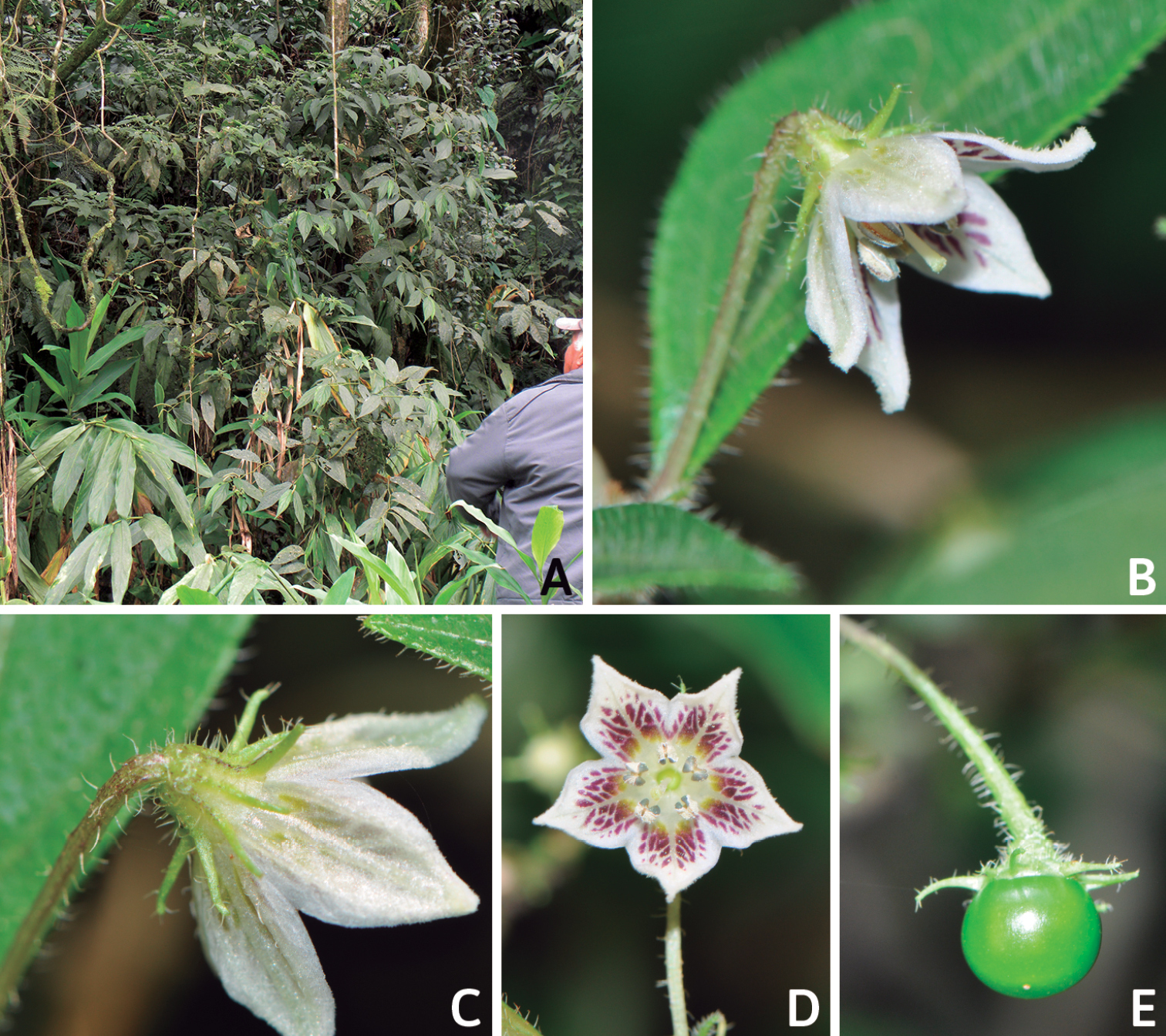
The flowers are often borne in groups of two to five at leaf axils, although solitary flowers occur. The slender flower stalk bends sharply near its tip, a feature botanists call geniculate. An open flower measures roughly 18–22 mm across.
Five broad, spreading lobes form a white, star-like corolla. Outside, it can carry purple and yellowish-green markings; inside, many small purple to reddish-brown spots appear between the veins and around the throat, surrounding a pale creamy centre.
Immediately behind the flower is the most recognisable structure: the green calyx with usually seven to ten unequal, narrow projections. The longer ones can reach about 5–6 mm, giving the flower a spiky, horned appearance. This is the character that inspired the scientific name.
Fruit & seeds
The fruit is a round berry measuring roughly 7–10 mm in diameter. It begins green and ripens to a distinctive greenish-golden yellow. This colour is important: wild Capsicum fruits are not all red at maturity.
The berries have thin, slightly translucent walls and are described in the scientific treatment as slightly pungent. They are carried on long, curved, downward-pointing fruit stalks. The calyx remains attached after flowering, with its narrow projections surrounding the base of the berry.
Inside are generally six to eighteen black seeds, sometimes fewer or more. Each is around 3–3.5 mm long. The dark seed colour and subtly textured seed coat are useful botanical details in a genus where many familiar cultivated peppers have pale seeds.
Range & habitat
This species is endemic to south-eastern Brazil and has been documented in limited areas of São Paulo and Rio de Janeiro. It grows in the Atlantic Forest, particularly humid, densely vegetated forest along the Serra do Mar mountain system.
Collections place it at approximately 500–900 metres above sea level, often in partial shade along steep ravines, forest margins and roadsides. These sites combine forest moisture with openings that provide some light.
Herbarium records used in the 2022 monograph show flowering from September to May, with fruits recorded from December into June. These are field-recorded seasonal windows rather than fixed rules for every population.
In parts of Rio de Janeiro, the local name pimentinha-do-mato has been recorded. It means roughly “little pepper of the bush” or “little wild pepper”.
Related species & identification
C. cornutum belongs to the Atlantic Forest lineage of Capsicum. Its chromosome count is 2n = 26 (13 pairs), rather than the 24 chromosomes found in many domesticated pepper species. This helps explain why the wild Atlantic Forest species form an important part of research into the evolutionary history of the genus.
It can look similar to the hairy Capsicum villosum, but C. villosum has about five more evenly sized calyx teeth and a different pattern of purple on the flower: larger marks near the base of each petal rather than the many fine spots of C. cornutum.
Another lookalike is Capsicum recurvatum. That species has shorter, backward-curving calyx projections and greenish-yellow flower markings without the characteristic purple spotting. Comparing the floral pattern, the calyx and the stem hairs is especially useful when the species grow in similar forest habitats.
Conservation
Wild C. cornutum occurs in scattered populations within the Atlantic Forest, much of which has been fragmented or cleared. Although some collections come from protected landscapes — including Itatiaia National Park, APA Cairuçu and reserves in the Serra do Mar — populations outside these areas remain vulnerable to habitat loss.
In their 2022 monograph, Barboza and colleagues gave the species a preliminary Vulnerable (VU) conservation assessment, referring to its limited range and ongoing reduction of suitable habitat. This is the authors' published assessment and should not be confused with a separately verified IUCN Red List entry.
Documenting wild peppers such as this one matters for conservation as well as plant science. Their distinctive flowers, dark seeds and unusual chromosomes preserve evolutionary diversity that cannot be represented by cultivated Habaneros, Cayennes or Bell Peppers alone.
Sources & photo credit
The botanical details, measurements and conservation assessment on this page come primarily from the published 2022 taxonomic treatment.
- Barboza, G. E., Carrizo García, C., de Bem Bianchetti, L., Romero, M. V. & Scaldaferro, M. (2022). Monograph of wild and cultivated chili peppers (Capsicum L., Solanaceae). PhytoKeys 200: 1–423, species 13; Figures 51–53.
- Royal Botanic Gardens, Kew. Capsicum cornutum (Hiern) Hunz., Plants of the World Online — accepted name, distribution and synonyms.
- USDA Agricultural Research Service. GRIN taxonomic record — nomenclatural publication date, geographic range and chromosomes.
- Carrizo García, C. et al. (2016). Phylogenetic relationships, diversification and expansion of chili peppers. Annals of Botany 118: 35–51 — Atlantic Forest lineage and comparative flower photographs.
- Photo: G. E. Barboza, Figure 53 in the 2022 monograph, Creative Commons Attribution 4.0. Photo plate displayed without alteration.