Overview
Capsicum dimorphum is a naturally occurring, wild Capsicum species from Colombia, Ecuador and Peru. Unlike the large-fruited peppers that people have selected for farming, this is a forest plant, with delicate branches, pairs of differently sized leaves and small berries.
The distinguishing feature is right in its name: the two leaves at a branch point can look like they belong to different plants. The larger leaf is elongated and pointed, while its partner is often short, rounded and almost stalkless. Its flowers add another distinctive feature: yellow petals that can be plain or marked with maroon-purple colour.
- Scientific name
- Capsicum dimorphum (Miers) Kuntze
- Family
- Solanaceae
- Native range
- Colombia, Ecuador & Peru
- Growth habit
- Scrambling shrub or subshrub
- Original name
- Brachistus dimorphus (1849)
- Current combination
- Published 1891
- Flowers
- Yellow, sometimes purple-spotted
- Habitat elevation
- About 950–3,000 m
History & naming
English botanist John Miers originally published the species in 1849 under the name Brachistus dimorphus. The original name reflects the older botanical classification, before the species was recognised within Capsicum.
In 1891, Otto Kuntze transferred it to Capsicum, creating the name Capsicum dimorphum. That is why the scientific author citation is written (Miers) Kuntze: Miers described the species, and Kuntze published its placement in the present genus. Both the 1849 and 1891 dates are part of its history.
The Latin-derived epithet dimorphum refers to two different forms. It suits the plant's conspicuously unequal paired leaves, a feature also used by modern botanists to distinguish the species from close relatives.
Plant & leaves
This species grows as a much-branched shrub or scrambling subshrub, often roughly 0.8–2 metres tall, sometimes reaching about 3 metres. The branches spread in a zigzag pattern, with slender younger stems that can be green, purple-tinged or maroon. Many plants have soft hairs on their stems and leaves, although hairiness varies among populations.
The leaf arrangement is the key to its appearance. At many branching points the leaves occur as a dramatically unequal pair. Larger leaves are generally thin-textured and elliptic, often around 4–12 cm long, with a tapering tip. Their much smaller companions are frequently rounded or ovate and nearly unstalked. Both leaves usually have smooth margins.
Some collections from Pasco, Peru, have much less hair and somewhat firmer leaves than typical plants from Colombia and Ecuador. Botanists nevertheless recognise them as the same species based on their flowers and fruits. This variation is part of the plant's natural range rather than evidence of a separate cultivated variety.
Flowers & their markings
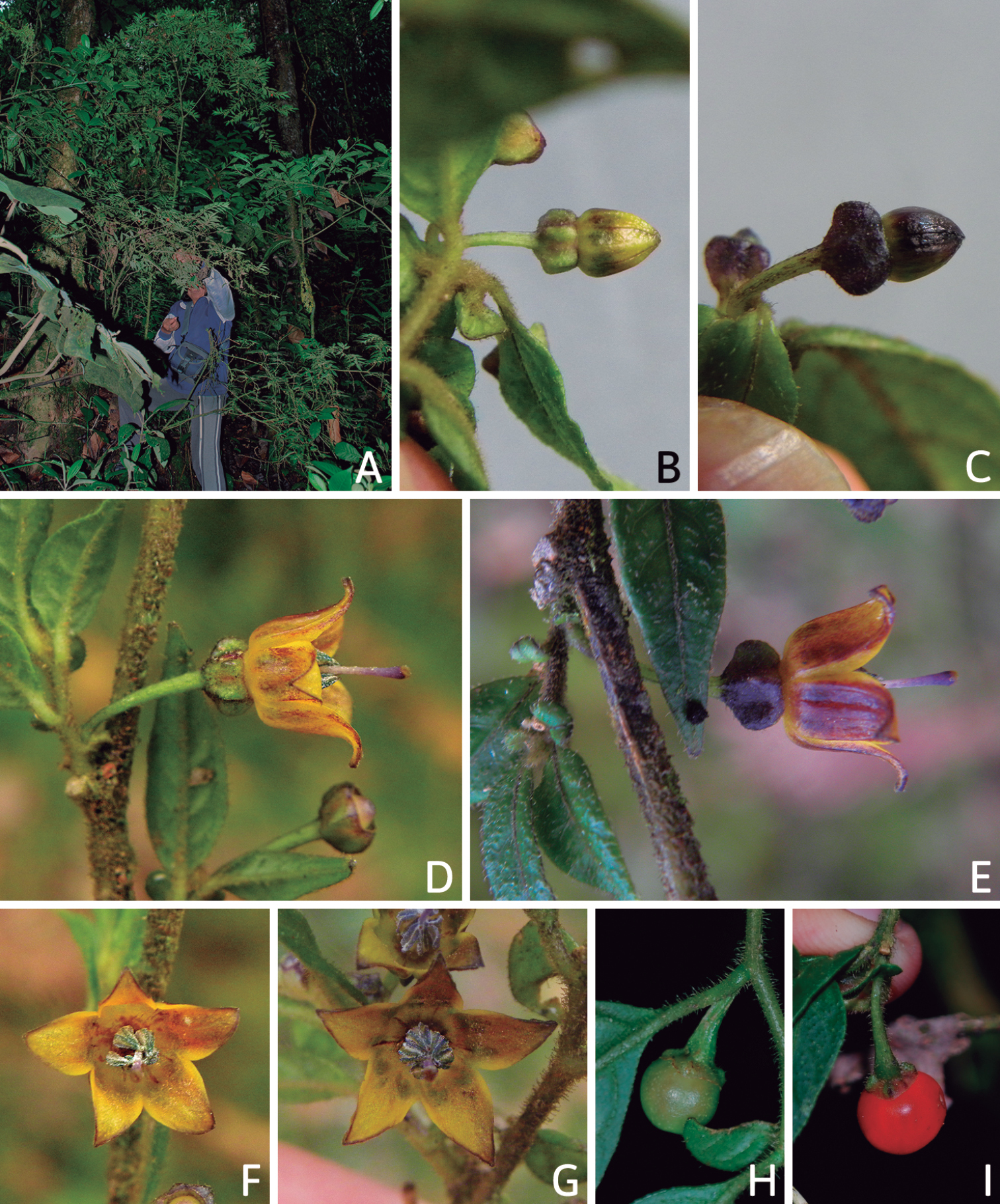
C. dimorphum produces flowers singly or in small groups of up to about five at the leaf axils. The petals form a spreading, roughly star-shaped corolla. Some flowers appear almost entirely yellow; others show striking purple or maroon spots or patches, particularly toward the inner part of the flower.
The buds may also be yellowish or purple. Different collected plants show noticeable variation in flower colour, a feature documented in the photographic series of the 2022 Capsicum monograph. Flowers are useful for identification because the species can share forest habitats with several other wild peppers.
The cup-like calyx behind the petals has no prominent horns. It is usually without appendages or bears only a few very short projections. This helps separate it from Andean relatives with much longer, more conspicuous calyx teeth.
Fruit & seeds
The berries are small and round, very different from the large pods of cultivated Capsicum annuum or C. chinense. Colombian herbarium observations describe fruits changing through orange before becoming red at maturity. The ripe berries form beside the plant's delicate flowers and paired foliage.
A particularly interesting distinction is that the 2022 taxonomic key describes the fruits as non-pungent. Wild pepper species do not all have the chemical heat associated with cultivated chillies, and the ability to distinguish pungent and non-pungent fruits is useful in studying how the genus evolved.
The seeds are small, approximately 1.9–2.7 mm long, and dark brown to black. This contrasts with the pale seeds typical of many cultivated chillies. Flower colour, seed colour, the strongly unequal leaf pairs and the subdued calyx projections are best considered together when identifying a specimen.
Range & habitat
The species occurs on the northern and central Andean slopes, with records throughout Colombia and Ecuador and southward into central Peru. It grows in humid premontane and montane forests, approximately 950 to 3,000 metres above sea level.
It has been collected at forest edges, among understory vegetation and inside both primary and secondary forests, including disturbed habitats. These are generally moist environments with shelter from the strongest direct sun, rather than the open, hot growing conditions associated with commercial chilli crops.
Botanical records show flowers and fruits throughout the year, reflecting the relatively mild seasonal conditions of many of its tropical mountain habitats. Colombian collections have recorded the local names Ahuyamo in Quindío and Mirtico de monte in Cauca and Cundinamarca.
Related species & identification
C. dimorphum belongs to the Andean lineage of wild Capsicum. Genetic research has recovered it close to Capsicum longifolium, a related species with similarly coloured flowers and small fruits.
The important differences are visible on the plant. C. dimorphum is usually hairier, has larger thin-textured leaves and bears solitary flowers or small groups of up to five. In C. longifolium, flowers typically occur in larger clusters and the calyx bears distinctive triangular or winged projections.
It can also grow near Capsicum geminifolium. That species has several long, fine calyx teeth and more bell-shaped flowers. Comparing the paired leaves, flower shape and calyx helps avoid confusion between these Andean forest peppers.
Conservation
Because the species has a relatively broad geographic range across three countries and occurs in multiple protected areas, the authors of the 2022 monograph proposed a preliminary Least Concern (LC) conservation assessment. This is the researchers' published assessment rather than a claim of a separately verified official IUCN Red List listing.
The persistence of mountain forests is still important for the plant and for many other specialised Andean species. Its distinctive leaf forms, flower patterns and non-pungent berries demonstrate how much botanical variation exists within Capsicum beyond the cultivated pepper varieties familiar to growers.
Sources & photo credit
This account is based primarily on the 2022 scientific monograph, with naming checked against the botanical name registers and a Colombian herbarium observation used for ripe fruit colour.
- Barboza, G. E., Carrizo García, C., de Bem Bianchetti, L., Romero, M. V. & Scaldaferro, M. (2022). Monograph of wild and cultivated chili peppers (Capsicum L., Solanaceae). PhytoKeys 200: 1–423, species 14; Figures 54–56.
- Royal Botanic Gardens, Kew. Capsicum dimorphum (Miers) Kuntze, Plants of the World Online — accepted name, native distribution and synonymy.
- International Plant Names Index. Capsicum dimorphum — original basionym Brachistus dimorphus Miers (1849) and Kuntze's 1891 combination.
- Jardín Botánico de Bogotá, Herbario JBB. Specimen Tovar 423 (2019), Valle del Cauca — notes on flower colour and orange-to-red fruit ripening.
- Photo plate: Figure 55 in Barboza et al. (2022), photos by G. Beltrán and G. E. Barboza; CC BY 4.0. Displayed without alteration; original figure and source.