Overview
Capsicum eximium is a wild, perennial pepper native to Bolivia and northwestern Argentina. It grows in dry inter-Andean valleys, open scrub and woodland edges rather than in the humid lowlands associated with many familiar cultivated chillies. In parts of its home range, its tiny fruits are gathered and the plant is known by the name ulupica.
The flowers make this species especially distinctive. Their five spreading lobes can be lilac, purple or almost white, with greenish-yellow tones toward the centre. A single population may contain plants with markedly different flower colours. The berries mature to bright red and are usually pungent, although naturally non-pungent plants have also been documented.
- Scientific name
- Capsicum eximium Hunz.
- Common name
- Ulupica
- Native range
- Bolivia & northwest Argentina
- Growth habit
- Perennial shrub or subshrub
- Height
- Usually 0.5–3 m; sometimes 4 m
- Flower colours
- White, cream, lilac or purple
- Ripe fruit
- Red, round, around 7–10 mm
- Conservation
- Least Concern
Discovery & naming
Argentine botanist Armando T. Hunziker formally described Capsicum eximium in 1950, publishing the name in the botanical journal Darwiniana. Its scientific history is closely tied to a collection he made on 6 May 1942 near Pampa Grande, in the Guachipas district of Salta Province, Argentina, at roughly 1,600 metres elevation.
That first collection contained fruiting branches. Hunziker grew seed from those plants in the botanical garden of the Faculty of Agronomy and Veterinary Medicine in Buenos Aires and collected flowering material on 4 March 1943. Those flowers later became especially important because flower structure and colour provide stronger evidence for recognising the species than the small red fruits alone.
In 2011, botanist Gloria E. Barboza selected the 1943 flowering specimen as the lectotype—the reference specimen that permanently anchors the scientific name. This provides a direct connection between the wild plants observed in Salta, the botanical garden where their seed was grown, and the modern identity of the species.
Plant & foliage
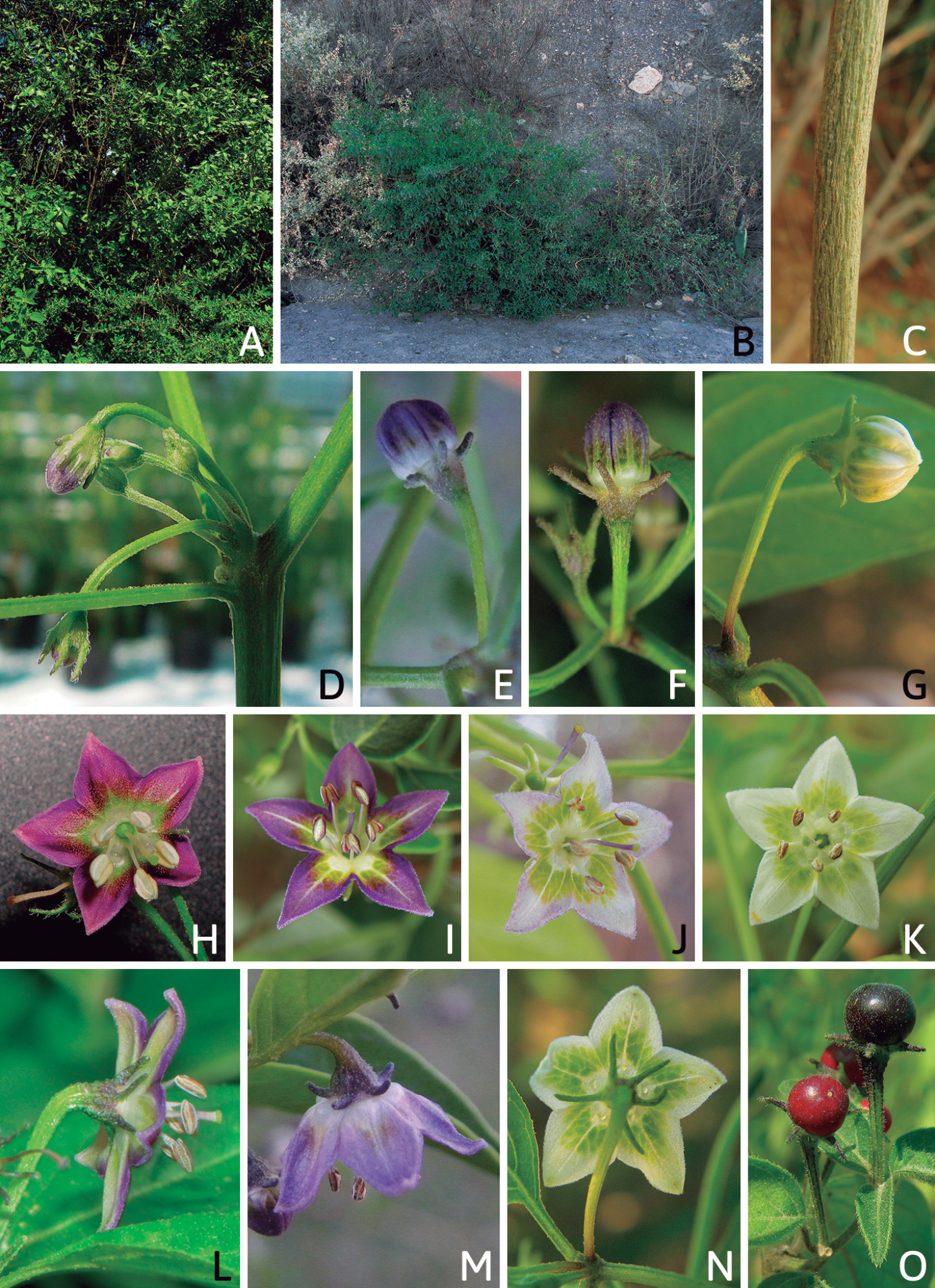
In favourable conditions, C. eximium develops into a densely branched shrub, generally about half a metre to three metres tall and occasionally taller. Mature plants may develop a stout woody base and greyish or brown, fissured bark. The upper branches are much more delicate: they bend at the nodes, often making a recognisable zigzag outline.
The leaves are thin, green and usually ovate to elliptic, with pointed tips and smooth edges. Larger leaves commonly measure a few centimetres to more than 10 cm in length; smaller leaves often occur alongside them at branching points. Young stems have fine, mainly non-glandular hairs, which help botanists distinguish C. eximium from other hairy wild peppers.
This is not simply a miniature version of a cultivated chilli plant. Its woody habit, flexible branches and ability to occupy dry, uneven ground are part of its adaptation to the Andean foothills and valleys.
Flowers & colour variation
The flower is the most variable and recognisable part of Capsicum eximium. Its small, star-shaped corolla is generally about 9–11 mm across. Some flowers are pale cream or nearly white; others have lilac, magenta or deep purple lobes. The centre can carry greenish-yellow or ochre colouring, giving many flowers a distinct two-tone appearance.
Botanist W. H. Eshbaugh reported observing white, cream and purple flowers within the same natural population. Later fieldwork confirmed considerable variation both between populations and among neighbouring plants. The colour is therefore not a reliable way to divide the species into separate varieties without additional evidence.
Behind the petals is a small calyx with usually five teeth, a useful identification feature. The corolla's shape and markings are especially valuable for telling C. eximium apart from closely related wild Bolivian peppers.
Fruit, seeds & heat
The berries are small and approximately spherical, typically 7–10 mm in diameter. They begin green, sometimes with dark purple or almost black patches, and may darken further before ripening bright red. The fruits stand on fairly upright stalks and detach readily when mature, unlike the persistent fruits of many domestic peppers.
A ripe fruit generally contains around 7–17 yellowish-brown seeds. The small size makes the berries suitable for picking and using whole, but it also means they are easy to overlook among the plant's branches.
One of this species' most interesting traits is that heat is not universal. Although fruits are often pungent, field observations from Tarija, Bolivia, recorded hot and non-hot plants from the same locality. This natural variation is useful to researchers studying how capsaicin production developed and changed during the evolution of peppers. An exact Scoville rating cannot represent the whole wild species.
Range & habitat
C. eximium has been recorded across several Bolivian departments, including La Paz, Cochabamba, Potosí, Santa Cruz, Chuquisaca and Tarija, and south into the Argentine provinces of Jujuy, Salta and Tucumán. The most southerly records from Tucumán are historical and need further confirmation, according to the 2022 monograph.
It is particularly associated with dry subtropical and inter-Andean valleys, usually between about 1,000 and 3,000 metres above sea level. Plants occur in deciduous woodland, Chaco scrub, rough pasture, forest remnants, along seasonal watercourses and at the edges of cultivated fields. Some sites are among thorny shrubs, cacti and dry-forest trees.
Field records place flowering mainly from November to April and fruiting from late December to May. These months describe observations in its native South American range, rather than a fixed growing calendar for gardens elsewhere.
Ulupica & local use
The name ulupica connects this species to a much wider local tradition of collecting and eating small wild peppers in Bolivia. It is important to note that ulupica is a shared common name: it can also refer to other wild species, notably Capsicum cardenasii, so a market name alone is not enough to confirm botanical identity.
People collect small wild peppers for their strong flavour and heat, and C. eximium is sometimes maintained on farms for household use. The 2022 monograph specifically notes that plants may be cultivated for self-consumption. Ulupicas are associated with Bolivian pepper sauces and condiments, including preparations in the broader llajwa tradition, where small chillies are combined with ingredients such as tomato and herbs. Individual recipes and the exact pepper species used vary by region and household.
These uses make C. eximium more than a botanical curiosity: it is a link between wild Andean plant diversity, local food knowledge and the history of peppers as everyday ingredients.
Related species & identification
Genetic studies place Capsicum eximium in the group of wild peppers often called the Purple Corolla clade. It has been studied alongside C. cardenasii and C. eshbaughii, species with overlapping botanical features and histories of local use.
One important piece of taxonomic history concerns Capsicum eximium var. tomentosum, a very hairy form named in 1971. Detailed comparisons showed that it differed substantially in its glandular hairs and more numerous calyx teeth. In 2011, Barboza recognised it separately under the name Capsicum eshbaughii.
Experimental crosses among some members of this group have produced fertile hybrids, demonstrating their close relationships. Nevertheless, the useful combination for identifying a typical C. eximium is its zigzag branches, mainly non-glandular hairs, five calyx teeth, variable star-shaped flowers and tiny red berries.
Conservation
The 2022 scientific monograph assessed Capsicum eximium as Least Concern because it occupies an extensive range and is relatively common in inter-Andean valleys. Kew's Plants of the World Online also reports an IUCN Least Concern listing for the species.
Although it is not presently considered among the most threatened wild peppers, preserving natural populations matters. They contain valuable variation in flower colour, fruit pungency and growth habit that cannot be captured by a few cultivated examples. Its presence across dry valleys, farmland edges and remnant woodland also offers an opportunity to document how wild and human-managed peppers coexist.
Sources & photo credit
This species account is based mainly on botanical taxonomic research, with historical nomenclature cross-checked against Kew, IPNI and the 2011 type-specimen revision.
- Barboza, G. E., Carrizo García, C., de Bem Bianchetti, L., Romero, M. V. & Scaldaferro, M. (2022). Monograph of wild and cultivated chili peppers (Capsicum L., Solanaceae). PhytoKeys 200: 1–423, species 16, Figures 59–61. Botanical description, distribution, field history and conservation.
- Royal Botanic Gardens, Kew. Capsicum eximium Hunz. — accepted scientific name, native range and IUCN status.
- International Plant Names Index. Capsicum eximium Hunz. — original publication, Darwiniana 9: 235 (1950).
- Barboza, G. E. (2011). Lectotypifications, synonymy, and a new name in Capsicum. PhytoKeys 2: 23–38 — original Hunziker collections, lectotype and distinction from C. eshbaughii.
- Photo plate: Figure 60, Barboza et al. (2022). Photos by G. E. Barboza (A–C, E–O) and P. Bosland (D), Creative Commons Attribution 4.0. Original photo plate. Displayed unaltered.