Overview
Capsicum flexuosum is a wild, perennial pepper found in southern and southeastern Brazil, Paraguay, and northeastern Argentina. It belongs to the same genus as Habaneros, Jalapeños and Rocotos, but looks very different from the familiar cultivated plants. Its branches spread and fork in a loose, angular pattern; small flowers hang from slender stalks, followed by shiny, round berries.
Its identifying combination is quite distinctive: white flowers with greenish-yellow markings, small red ripe fruit, and brownish-black seeds. Botanical studies recognise it as the sole species in a separate genetic group, the Flexuosum clade. It is not a domesticated chilli variety.
- Scientific name
- Capsicum flexuosum Sendtn.
- Type
- Wild perennial shrub
- Native range
- Brazil, Paraguay, Argentina
- First described
- 1846
- Typical height
- About 0.9–2 m
- Flowers
- White with greenish-yellow spots
- Ripe fruit
- Red; around 5–8 mm
- Seeds
- Brownish-black
Discovery & naming
German botanist Otto Sendtner published the name Capsicum flexuosum in 1846, in the tenth volume of Flora Brasiliensis. The original account referred to plants gathered in southern Brazil by the explorer and plant collector Friedrich Sellow. The word flexuosum describes something bent or winding, fitting the plant's distinctive, irregular branching.
The identity of this species has not always been straightforward. Over the years, botanists described similar plants under names such as Capsicum ramosissimum and Capsicum mositicum; both are now treated as synonyms of C. flexuosum. Some older records also placed it within Capsicum schottianum.
The 2022 monograph recorded that the only original Sellow material the researchers could identify had been held in Berlin and was destroyed during the Second World War. To give the name a stable scientific reference, the authors selected a modern preserved specimen collected near Curitiba, Paraná, in December 1979 as its replacement type specimen (neotype). The result links the nineteenth-century name with a carefully documented modern plant.
Plant & foliage
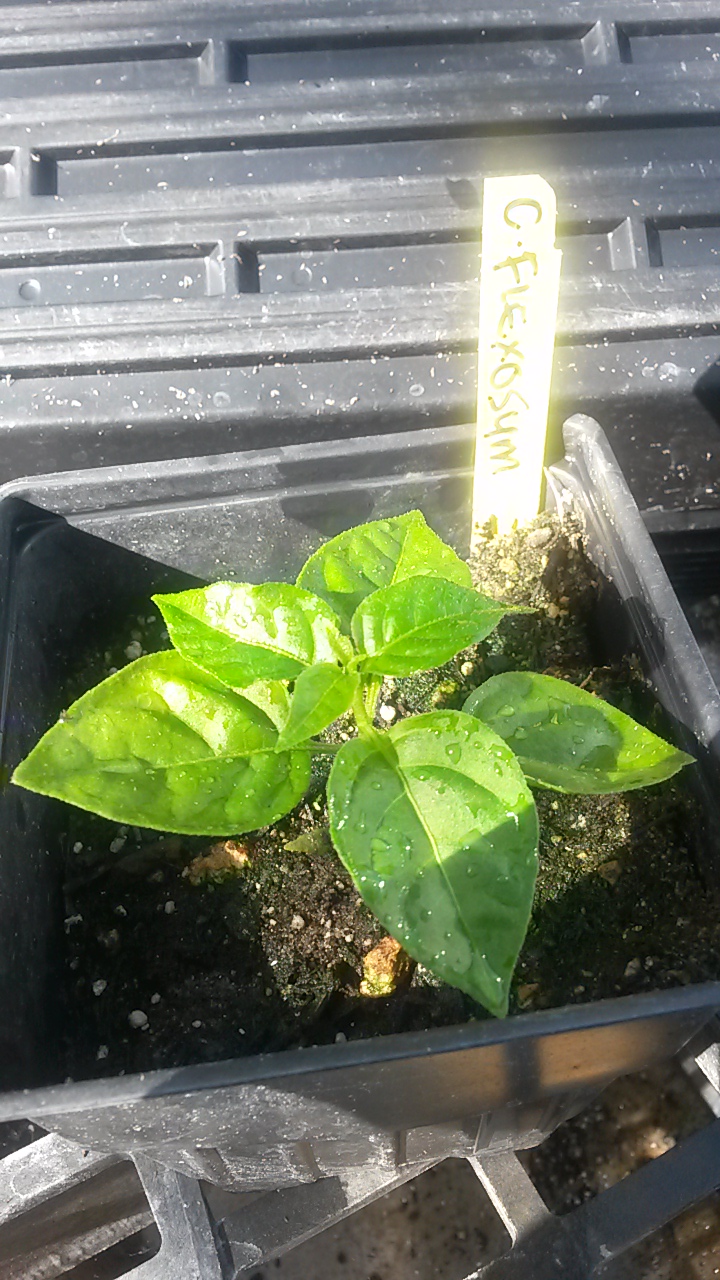
In the wild, most plants grow as upright shrubs around 0.9–2 metres tall, although small tree-like specimens may approach 2.5 metres. Older stems become woody and dark brown. Young branches may be smooth or covered in fine hairs; the amount of hair varies considerably between populations.
Branching often creates a zigzag, widely spreading outline. Some specimens develop particularly crowded sprays of twigs, leaves, flowers and fruit. That unusual habit once helped inspire the separate name C. ramosissimum, meaning very highly branched. The thin, pointed leaves are dark green above and paler underneath, often occurring as unequal pairs at the same node.
White flowers with green markings
Its small flowers are generally star-shaped, white and around 13 mm across, with yellowish-green areas around the centre and on the inner petals. The markings may appear as several small spots or larger patches. A few populations, particularly near Monteiro Lobato in São Paulo, also show purple markings mixed with the greenish-yellow colouring.
Flowers grow singly or in small groups, commonly two to six at a leaf axil. Their stalks usually hang downward and do not have the sharp elbow-like bend found in certain closely related wild species. The calyx is small, sometimes with five very low points rather than prominent teeth. Taken together, the stalk and flower features help botanists tell this species apart from C. schottianum and C. campylopodium.

For close views of the spotted flowers, branches and berries from scientific field collections, see Figure 63 of the 2022 Capsicum monograph, photographed by C. Carrizo García.
Fruit, seeds & heat
The fruits are tiny, glossy berries measuring about 5–8 mm across. They begin bright green and usually ripen through orange-red to red. Mature fruit hangs on a slender stalk and can detach readily from the plant. A berry may contain roughly 5–25 brownish-black seeds, although fewer occasionally occur. This dark seed colour is a useful clue that distinguishes many wild peppers from the familiar pale-seeded cultivated chillies.
The 2022 monograph describes the fruits as pungent, and collectors in Argentina and Paraguay have recorded their use as strongly flavoured condiments. However, genetic research has also noted non-pungent populations. That means a single Scoville figure cannot properly describe every wild plant of this species. It should not be confused with cultivated varieties that have been selected for predictable heat.
Range & habitat
Capsicum flexuosum has a relatively extensive range for a wild pepper. Botanical records place it in São Paulo, Minas Gerais, Paraná, Santa Catarina and Rio Grande do Sul in Brazil; across several departments of Paraguay; and in Misiones and Corrientes in northeastern Argentina.
It grows within and along the edges of primary and secondary forests, particularly the Atlantic Forest, but can also persist in forest remnants and disturbed woodland. The species has been recorded from approximately 30 to 1,300 metres above sea level. Researchers report flowering during much of the year in its native range, with mature fruits observed in many months rather than in one brief season.
Its presence in a variety of forest types helps explain why the species is more broadly distributed than many highly localised wild Capsicum relatives.
The cold-tolerance reputation
Among specialist pepper growers, C. flexuosum has earned a reputation as one of the more cold-tolerant wild peppers. Growers in cool climates have reported plants surviving frosty nights and regrowing after colder weather that would damage ordinary garden chillies. Its woody, perennial habit also makes it appealing to people who enjoy keeping peppers for several seasons.
Some seed sellers report survival at temperatures as low as −12 to −15°C. Those are grower and seller reports, not a verified hardiness limit established by controlled trials. Survival depends on factors such as the plant's age, soil conditions, length of exposure, shelter and whether the roots freeze. The safe approach is to protect young plants and avoid treating any single temperature as a guarantee.
The wider scientific interest lies in whether naturally adapted wild peppers may offer useful traits for future research into cold tolerance. That is a promising question, but it should not be confused with proof that C. flexuosum can reliably pass frost resistance to cultivated peppers through ordinary crosses.
Local names & traditional use
Across its large native range, the species has acquired many local names. Brazilian herbarium labels record pimenta-braba, pimenta de passarinho and pimento-do-mato, while Argentine records include cumbarí, pimentina and pimienta del monte. The same common names can be used for other small wild chillies, so they are not always precise species identifiers.
Herbarium records from Argentina and Paraguay describe gathering its hot berries for use as condiments. This is a practical tradition of using wild peppers, not evidence of a widely domesticated crop. The species is best understood as part of the local diversity of edible wild plants rather than a standard commercial chilli.
Relationships & identification
Molecular studies place Capsicum flexuosum in the Flexuosum clade, separate from the main groups containing cultivated species. In outward appearance, it is especially similar to C. campylopodium and C. schottianum, all of which may have white flowers with coloured markings and very small berries.
The best distinguishing combination is the downward-hanging flower stalk without a pronounced elbow, white flowers with greenish-yellow marks, ripe red berries and dark seeds. In contrast, typical C. campylopodium and C. schottianum have greenish-golden ripe fruit and differently shaped flower stalks. The unusual branching and variable leaf hairs provide additional clues, but cannot settle every identification on their own.
Conservation
Unlike several extremely rare wild Capsicum species, C. flexuosum remains relatively widespread. The 2022 botanical monograph gave it a preliminary Least Concern assessment, noting its large overall range, numerous records and occurrence in protected areas. This is the researchers' species assessment, not a claim that every local population is secure.
Forest clearing and fragmentation can still affect individual populations. Protecting remnants of the Atlantic Forest helps preserve the species' natural genetic variation, including differences in flower colour, leaf hairiness and fruit pungency. Its unusual position within the Capsicum family tree also makes it valuable for understanding how wild peppers evolved.
Sources & photo credits
This page uses published botanical descriptions for the plant and its distribution. Claims about extreme cold tolerance are clearly separated from scientifically established facts.
- Barboza, G. E., Carrizo García, C., de Bem Bianchetti, L., Romero, M. V. & Scaldaferro, M. (2022). Monograph of wild and cultivated chili peppers (Capsicum L., Solanaceae). PhytoKeys 200: 1–423. Species 17, Figures 62–63. Botanical description, distribution, local names and conservation.
- Royal Botanic Gardens, Kew. Plants of the World Online: Capsicum flexuosum. Accepted name, synonyms and native distribution.
- Carrizo García, C. et al. (2016). Phylogenetic relationships, diversification and expansion of chili peppers. Evolutionary relationships and variation in pungency.
- U.S. Department of Agriculture. GRIN-Global taxonomy record. Historical names and common names.
- For the growing community's cold-weather observations, see Cicada Seeds' grower account and Small Island Seed Co.'s cultivation notes. These are anecdotal reports, not experimental survival trials.
- Photographs by Horticulturalist RJ, via Wikimedia Commons. Both photographs are available under Creative Commons Attribution-ShareAlike 4.0; direct original-file credits are linked beneath each image.