Overview
Capsicum geminifolium is a wild member of the pepper genus found in Colombia, Ecuador and Peru. Rather than an agricultural chilli, it is a shrub of humid mountain forests, where its branches carry unequal pairs of narrow leaves and groups of hanging yellow flowers.
It is one of the Andean relatives that broaden the picture of what a pepper can be. The small fruits are pale orange when mature and non-pungent, and their seeds are black rather than the light-coloured seeds familiar from many domesticated varieties. Both its flowers and the narrow projections around their bases are particularly valuable for identifying the species.
- Scientific name
- Capsicum geminifolium (Dammer) Hunz.
- Family
- Solanaceae
- Native range
- Colombia, Ecuador & Peru
- Growth habit
- Shrub or subshrub
- Original description
- 1905, as Acnistus geminifolius
- Accepted combination
- 1956
- Flowers
- Yellow, sometimes purple-spotted
- Mature fruit
- Pale orange; non-pungent
Discovery & naming
The plant's documented history reaches back to botanical work in Ecuador in the nineteenth century. A specimen collected by the Jesuit botanist Luis Sodiro in the forests around Monte Corazón in September 1873 was later selected as the reference specimen for its original scientific name.
German botanist Udo Dammer described the species in 1905 as Acnistus geminifolius. At the time it was placed in a different genus, reflecting the changing understanding of how the nightshade family is organised. Armando T. Hunziker later placed it in Capsicum, giving it the current combination Capsicum geminifolium. That combination appeared in proceedings of a 1954 botanical congress which were published in 1956.
There was another chapter in the naming story. In 1961 Hunziker published Capsicum scolnikianum from material collected by R. Scolnik in Peru in 1948. Later research found that these plants belong within C. geminifolium. The name C. scolnikianum is now treated as a synonym, not a separate accepted species.
The name geminifolium alludes to paired leaves. This is especially apt because each pair often contains one long leaf and one much smaller companion.
Plant & leaves
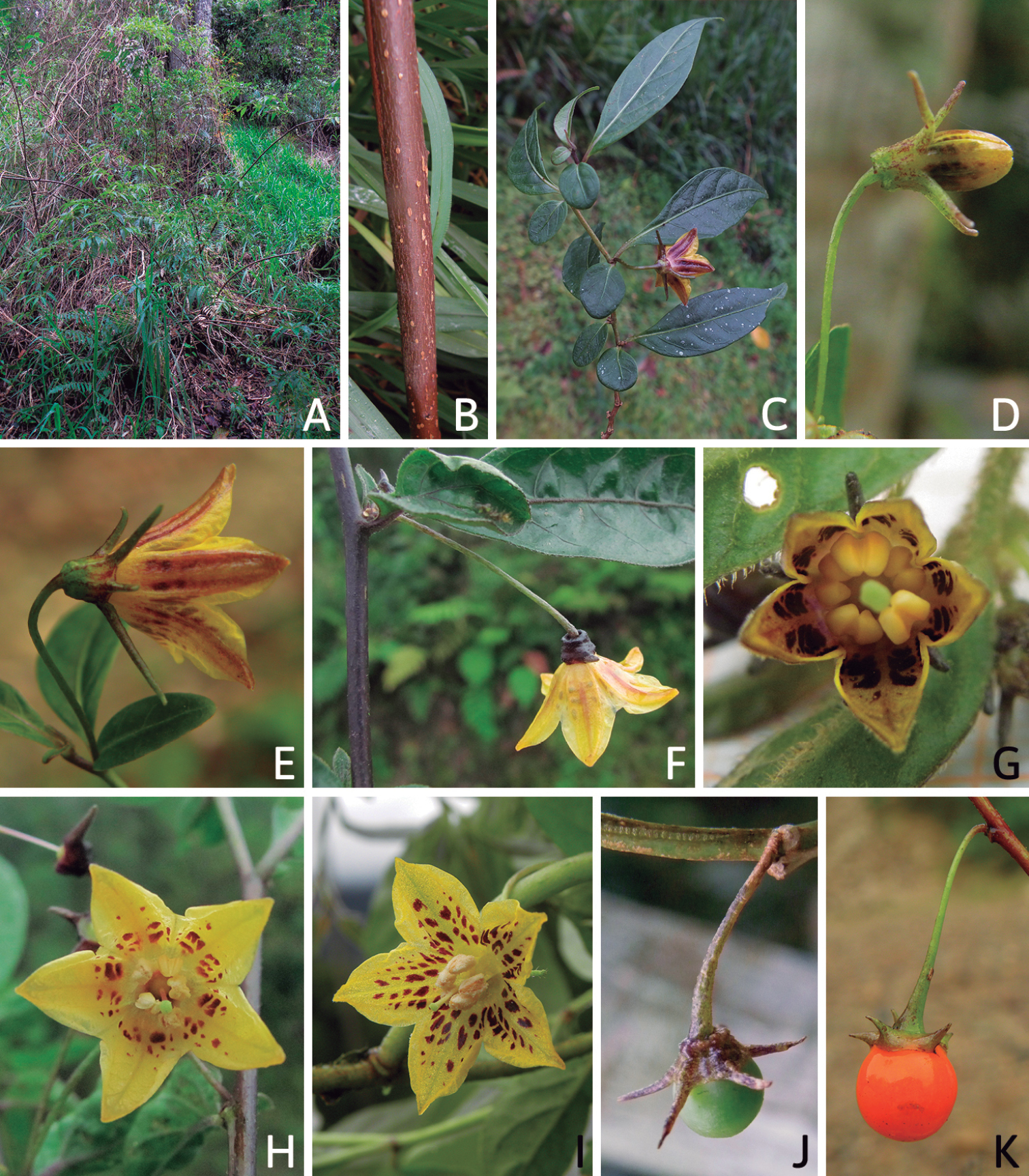
Most plants grow as erect, branching shrubs or subshrubs around 1–4 metres tall, although the 2022 botanical treatment records exceptional plants reaching about 6 metres. Some stems scramble through nearby vegetation. Young stems may be green with a hint of purple, while older bark becomes dark brown or grey and shows small pale lenticels.
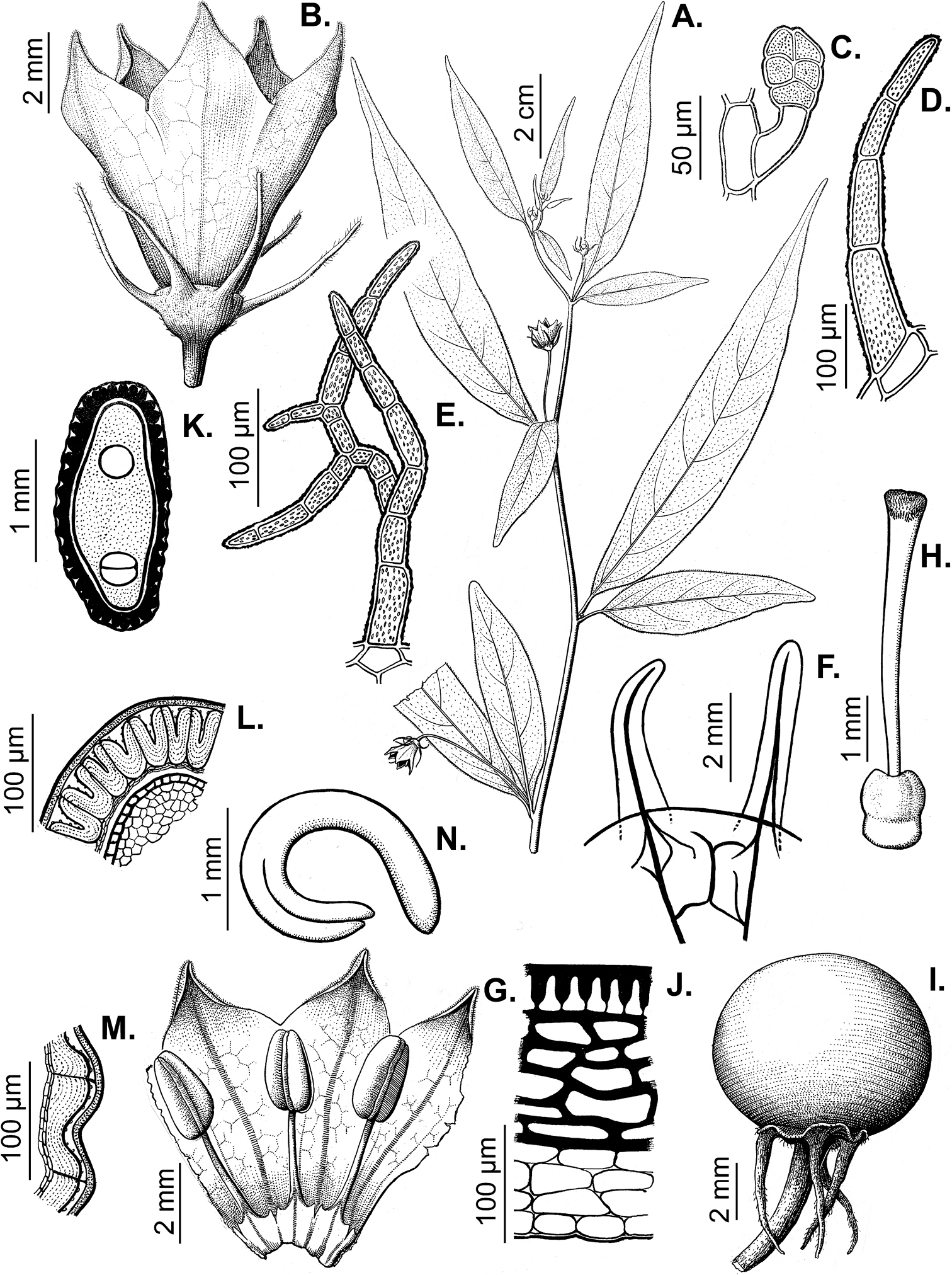
The leaves are thin and often noticeably narrow. A larger leaf in a pair is typically 4–13 cm long, elliptical to narrowly elliptical, with a pointed tip and smooth edges. Its shorter partner can be only 0.8–5 cm long, often broader in proportion and more rounded at the tip. The upper surfaces are deep green; the undersides may be paler or purple-tinged.
Fine pale hairs occur on the leaves and young stems, although their abundance varies between collected plants. In forest conditions, the slender branches and uneven paired foliage give this pepper a very different appearance from the compact, broad-leaved plants often seen in chilli gardens.
Flowers & calyx
Flowers usually appear in small groups of two to five at the leaf joints. Each hangs from a slender stalk, commonly around 15–25 mm long. The flowers are gently bell-shaped, with five petals forming a star-like outline, and measure roughly 13–18 mm across.
The main colour is dull or golden yellow. Some flowers are nearly uniform yellow, while others carry maroon or purple freckles inside the corolla. A few can appear strongly purple on the outside. The anthers are usually cream or yellow rather than the bright blue sometimes seen in other peppers.
A distinctive feature sits immediately behind the flower: the calyx usually has two to five slender, sometimes fleshy projections. These can be green, purple-tinged or deep purple, and often reach several millimetres in length. Together with the yellow flower and hanging stalk, they are among the best clues for recognising the species.
Fruit & seeds
The berries are small and nearly spherical, usually 7–12 mm across. They begin light green and mature through pale orange to orange. This colour is important: not all wild peppers produce the bright red berries associated with bird peppers and many cultivated chillies.
Modern botanical descriptions classify the ripe fruits as non-pungent. They have a relatively thick fruit wall, and, unlike many domesticated peppers, their fruit tissues lack certain enlarged cells studied in Capsicum anatomy. A mature berry may drop from its stalk rather than remain attached for a long period.
Each berry holds several to many black, teardrop-shaped seeds, typically around 1.8–2.3 mm long. The dark seed colour, yellow flowers and projecting calyx together distinguish this forest species from the commonly grown peppers with pale seeds and intensely hot fruit.
Range & habitat
Capsicum geminifolium grows in the northern Andes across Colombia, Ecuador and Peru. The species has been collected in both intact and regrowing mountain forests, along edges and in openings where some filtered light reaches the understory.
The 2022 monograph records plants mainly between roughly 950 and 3,500 metres above sea level, with an occasional much lower record. These are often moist, cloud-influenced environments with cooler temperatures and more dependable humidity than the places where commercial chilli peppers are usually grown.
Flowering and fruiting specimens have been documented throughout the year. The broad geographic range and variety of forest settings explain why this species appears in many herbarium collections, despite being unfamiliar to most pepper growers.
Related species & identification
Genetic studies place C. geminifolium in the Andean group of wild Capsicum, which includes species such as C. dimorphum, C. hookerianum and C. lycianthoides. These plants are important to understanding the genus beyond its domesticated branches.
The closest lookalike in the field and in older specimen collections is often Capsicum lycianthoides. Both can have yellow flowers and overlapping ranges, but geminifolium usually has longer flower stalks, thinner and narrower leaves, and a more star-shaped bell-like corolla. C. lycianthoides tends to have broader, firmer leaves and a wider, more pentagonal flower outline.
Some older publications treated C. scolnikianum separately and confused the characters of C. geminifolium with those of C. lycianthoides. Modern comparisons of specimens and DNA have helped settle those boundaries. For identification, using leaf pairs, flower stalk length, petal shape, calyx teeth and ripe fruit colour together is more dependable than relying on one feature alone.
Conservation
The 2022 Capsicum monograph proposed a preliminary Least Concern (LC) assessment for C. geminifolium. The authors noted its wide distribution, relatively frequent records and presence within numerous protected areas. That is their published scientific assessment, not a separate claim of an officially verified IUCN listing.
Its natural setting remains dependent on healthy Andean mountain forests. Protecting those forests also preserves wild pepper diversity, including features not usually found in farmed chillies: non-pungent orange berries, black seeds, long flower stalks and unusual flower colours.
Sources & photo credits
This page is based primarily on the species treatment in the 2022 Capsicum monograph, checked against Kew and original naming records.
- Barboza, G. E., Carrizo García, C., de Bem Bianchetti, L., Romero, M. V. & Scaldaferro, M. (2022). Monograph of wild and cultivated chili peppers (Capsicum L., Solanaceae). PhytoKeys 200: 1–423. Species 21, Figures 71–72.
- Royal Botanic Gardens, Kew. Capsicum geminifolium, Plants of the World Online — accepted name, distribution and synonyms.
- Barboza, G. E. (2011). Lectotypifications, synonymy, and a new name in Capsicum — historical collections and original type specimen.
- International Plant Names Index. Capsicum geminifolium — publication details of the accepted combination.
- Photo plate: Figure 72 in Barboza et al. (2022), photographs by G. E. Barboza, R. Deanna and A. Orejuela. Botanical drawing: Figure 71, illustrated by L. Sánchez. Both from an open-access CC BY 4.0 publication; no alterations made.