Overview
Capsicum lanceolatum is a wild pepper native to southern Mexico, Guatemala and Honduras. It lives mainly in wet mountain forests and cloud-forest landscapes, often on steep slopes, along ravines and beside forest streams. Unlike the familiar cultivated chillies, it is an upright, slender shrub whose slender branches bear strikingly unequal pairs of leaves and mostly single, hanging flowers.
Its appearance is distinctive: white-edged, purple flowers have the shape of a small bell, while nearly spherical fruit ripens from green to orange or orange-red. The ripe fruit is non-pungent, and a cut berry reveals numerous dark, almost black seeds. Long, narrow, green projections at the base of each fruit curl backwards like a small crown.
The plant is particularly significant because a published search of its former Guatemalan sites could not relocate it. Its rediscovery in a protected cloud forest became a widely cited example of how reserves preserve plant diversity that can otherwise be overlooked.
- Scientific name
- Capsicum lanceolatum (Greenm.) C.V.Morton & Standl.
- Family
- Solanaceae
- Native range
- Mexico, Guatemala & Honduras
- Growth habit
- Erect shrub, usually 1–3 m; occasionally 5 m
- Earliest cited collection
- 1877, Guatemala (under a later synonym)
- Original description
- 1904, as Brachistus lanceolatus
- Current combination
- 1940
- Flower colour
- Purple with white margins
- Ripe fruit
- Orange to orange-red, 7–13 mm
- Pungency
- Non-pungent
- Chromosomes
- 2n = 26 (13 pairs)
- Conservation
- Endangered (2022 published assessment)
Discovery & naming
Herbarium collections trace this pepper back into the nineteenth century. The 2022 botanical monograph cites material gathered by Carl Gustav Bernoulli and Rudolf Cario at Las Nubes, Guatemala, in November 1877. That specimen later became the reference for the name Capsicum guatemalense, published by Georg Bitter in 1924. Today that name is treated as a synonym of C. lanceolatum.
The species' original scientific name was based on a different collection. In April 1889, botanist John Donnell Smith collected plant number 1837 at Chucaneb in Alta Verapaz, Guatemala, at about 1,850 metres. This specimen, now preserved in the Smithsonian's United States National Herbarium as US 00027406, is the holotype of Brachistus lanceolatus.
Jesse More Greenman associated the specimen with the epithet lanceolatus, and the description appeared in the Botanical Gazette in 1904. At that time the plant was placed in Brachistus, another genus in the nightshade family. In 1940, American botanists Conrad Vernon Morton and Paul Carpenter Standley transferred it to the pepper genus, publishing the name now accepted as Capsicum lanceolatum.
The epithet lanceolatum refers to the lance-shaped larger leaves, which taper into a long point. This old Latin botanical term is a precise description of one of the most obvious features of the plant. Modern nomenclatural references recognise Brachistus lanceolatus and Capsicum guatemalense as synonyms of the accepted species.
Early Guatemalan collection
Bernoulli and Cario collect material at Las Nubes, later used for the name C. guatemalense.
Name-bearing reference specimen
John Donnell Smith collects specimen 1837 at Chucaneb, Alta Verapaz.
First published description
The species is described as Brachistus lanceolatus.
A second scientific name
Georg Bitter publishes Capsicum guatemalense, now treated as a synonym.
Transferred to Capsicum
Morton and Standley publish the accepted combination Capsicum lanceolatum.
Rediscovery documented
Bosland and González publish their report of a surviving population in Guatemala.
Major taxonomic review
A detailed monograph revises the descriptions, synonyms, distribution and conservation assessment.
The rediscovery in Guatemala
The species has one of the more memorable modern histories among wild peppers. Paul W. Bosland and Max M. González investigated Guatemalan sites where earlier botanists, including collectors working during the 1930s, had recorded Capsicum lanceolatum. In their 2000 paper, they reported that the pepper was absent from all its previously known locations; sites had changed substantially after forest clearing and land conversion.
The search did, however, find living plants in an area that had escaped these changes: the Biotopo del Quetzal, a protected remnant of Guatemalan cloud forest. The reserve is also associated with the resplendent quetzal, the bird for which it was created. The researchers described this as a rediscovery after more than fifty years, making the survival of this obscure wild pepper an example of the value of protecting entire forest habitats rather than only better-known species.
The newly documented population showed differences in flower and seed characters from historical specimens. Bosland and González considered these differences evidence that the reserve held a previously unrecognised population of the same species. Their work did not mean the species existed only there: later botanical records and the 2022 monograph document a wider distribution across three countries. The important finding was that the historical Guatemalan sites surveyed had lost their known populations, while the protected forest retained one.
The story also illustrates the limits of judging extinction from old collecting records alone. A pepper can disappear from places botanists once knew and yet persist in isolated gullies or forest patches. Locating those surviving populations makes it possible to study the living plant, compare it with preserved specimens and conserve its genetic diversity.
Plant & leaves
C. lanceolatum is an erect, branching shrub or subshrub, ordinarily 1–3 metres tall, but occasionally reaching 5 metres. Its many flexible branches arise from near the base. New stems are green, slender and rather fragile; older branches develop brown bark. The plant is mostly smooth, with only scattered small whitish hairs, particularly on some young stems and the undersides of leaves.
The foliage occurs in strongly unequal pairs at the branching nodes. A larger leaf is typically 6.5–16 cm long and 1.4–3.8 cm wide, narrow-elliptical to lance-shaped, with a long pointed tip, smooth margin and a base tapering towards its short stalk. The smaller companion leaf is usually only 1–5.5 cm long and tends to be broader, oval-shaped and much more shortly stalked.
Leaves are green on both surfaces, from thin and soft to relatively firm. The upper surface is ordinarily hairless, while scattered fine hairs may be present below, especially along the veins and edges. The pronounced difference between the two leaves in each pair helps distinguish this species from the familiar bird peppers and cultivated C. annuum, whose leaf pairs are not so strongly contrasting.
The thin architecture, long flowering stalks and uneven foliage are suited to a plant growing among other shrubs under the humid forest canopy rather than a heavily managed, bushy field crop.
Flowers & calyx
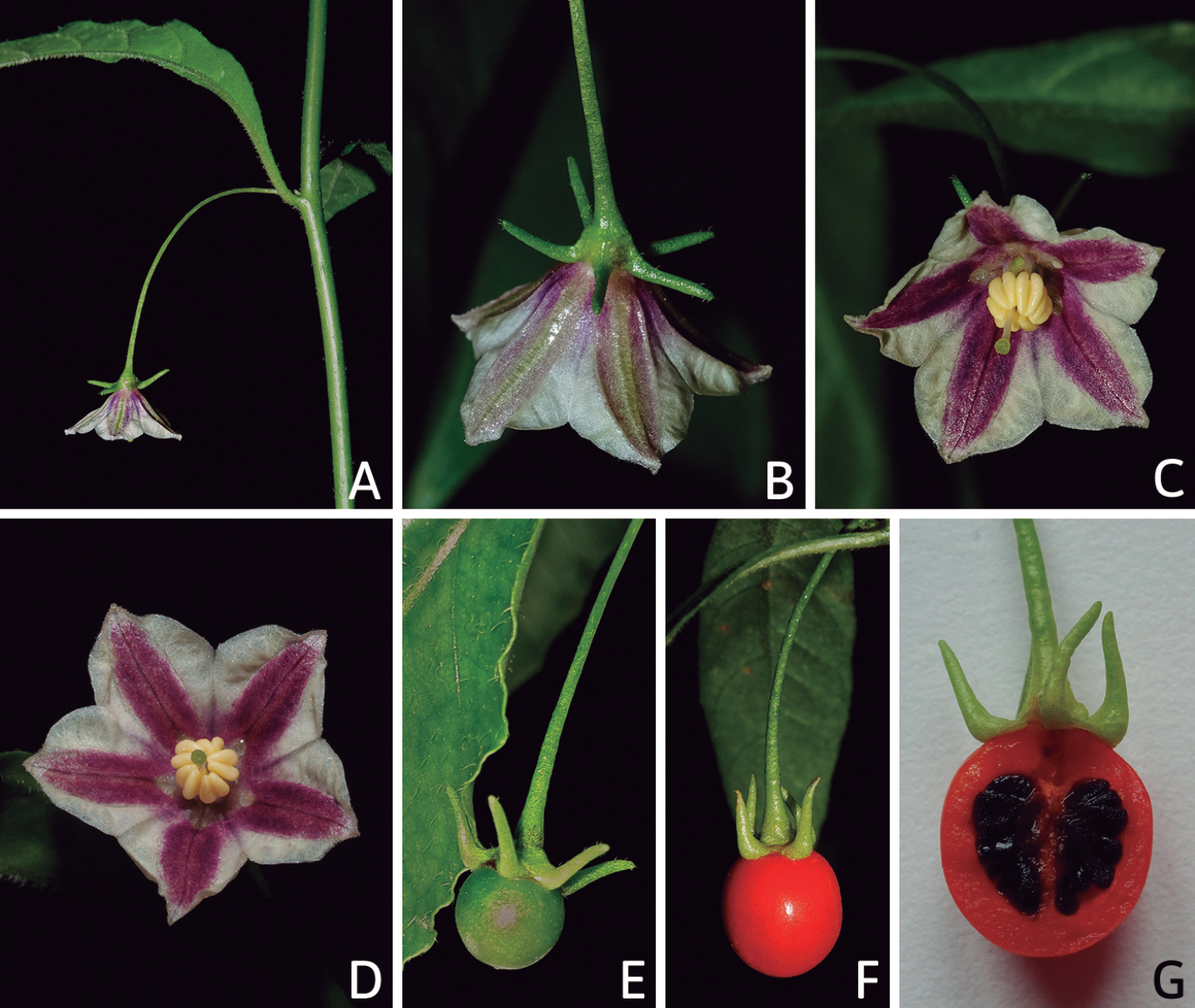
Flowers usually grow one at a time from a leaf axil, with a pair occurring occasionally. They hang from slender, smooth stalks typically 25–43 mm long, sometimes as short as about 15 mm. The buds are purple or yellowish-purple, and an open flower is roughly 10–15 mm across and 9.8–14 mm long.
The corolla is bell-shaped and prominently purple with white margins. The purple pigment forms broad areas on the petals, while the thinner tissue between them contributes a pale outer edge. Five short lobes spread around the opening. Seen face-on, the pale border and deep purple sections give the blossom a striking star-like pattern, although its overall three-dimensional shape is more of a hanging bell than a flat star.
At its centre are five stamens with pale yellow to creamy anthers, often held closely together. The style extends beyond the anthers and ends in a small, sometimes slightly two-lobed green stigma. Unlike some other wild peppers, the corolla surfaces are essentially hairless.
The calyx is particularly diagnostic. Immediately behind the flower sit usually five long, narrow, pointed projections, about 2–5 mm long at flowering. They spread sideways or bend sharply backward. As the fruit grows, these appendages remain and may reach 4–9 mm. With the long hanging stalk, they are among the clearest signs that a plant is C. lanceolatum.
Fruit & seeds
The berries are round or slightly flattened, generally 7–13 mm across. They begin green and turn orange to orange-red at maturity, often appearing glossy. Fruit hangs from slender stalks approximately 30–55 mm long. The stalk widens near its junction with the calyx, where a noticeable ring-like narrowing marks the point at which the calyx begins.
The ripe berries are described as non-pungent in the modern monograph. In other words, they do not produce the characteristic burning heat of cultivated hot chillies, even though they belong to the same genus. The fruit wall is relatively thick and smooth internally; it lacks the enlarged internal fruit cells recorded in many pungent Capsicum species.
Each berry commonly holds 29–60 dark brownish-black to black seeds, with the scientific description recording occasional counts as high as 93. These are small, about 2–2.5 mm long, often curved like the letter C or shaped like a teardrop. Their surfaces show a fine net-like pattern under magnification. When the berry is cut across, the dark seeds are conspicuous against its red-orange flesh.
The green calyx appendages curl strongly backwards around the ripe fruit, creating an almost horned appearance. They stay attached even after the corolla has fallen, so fruits can often be identified with more confidence by checking their stalk, calyx and seeds together than by colour alone.
Range & habitat
This species belongs to the Mesoamerican forests from southern Mexico through Guatemala to Honduras. Documented Mexican records include Chiapas, Oaxaca and Veracruz. Guatemalan material has been collected in a number of departments, particularly in mountain areas, while Honduran collections include sites in Comayagua, Cortés and La Paz.
It grows in montane rain forest, cloud forest, forest remnants and regenerating or disturbed mountain forest, particularly on steep hillsides, in wooded ravines and alongside streams. The comprehensive 2022 treatment places most records around 1,000–3,000 metres above sea level, while noting an exceptional record down to approximately 100 metres. Earlier accounts of the species often emphasised the humid cloud forests at about 1,200–1,800 metres.
These habitats receive frequent moisture and can remain cool, humid and shaded, quite unlike the conditions of many commercial chilli fields. Forest edges and small breaks in the canopy can also support plants. The available specimen records show flowering from May to December and fruiting throughout the year, referring to observed seasons in its native distribution.
Although its geographic range covers several countries, populations are scattered among suitable forest patches. The history of land conversion in Guatemala shows why a broad map range should not be mistaken for an uninterrupted distribution or a secure population.
Local names & cultural record
The 2022 monograph preserves several local names associated with collected specimens. In Guatemala, these include pajarito del río and yerba de pajarito, both recorded from Quetzaltenango. The words refer to a small bird or bird-related plant, a reminder that local plant names are often linked to the setting in which people encounter a species.
In Chiapas, Mexico, records include the Tzeltal names tumattez and chuj ch'ul tumaltez. These are specimen-linked names rather than trade names for cultivated peppers. Their preservation is useful because historical botanical labels sometimes retain local vocabulary that would otherwise be easy to lose from formal scientific accounts.
C. lanceolatum is primarily known as a wild forest plant, not a named domesticated chilli variety. Its importance is botanical and cultural as a native member of the pepper family whose local names, collecting history and natural setting connect it with the landscapes of southern Mexico and Central America.
Genetics & related species
Genetic research places Capsicum lanceolatum in the Andean evolutionary group of wild peppers. Despite that group's name, this species grows much farther north, in Mexico and Central America. It is part of a lineage distinct from the major domesticated chilli groups containing C. annuum, C. chinense and C. frutescens.
It has 26 chromosomes, arranged as 13 pairs (2n = 26). This contrasts with the 24 chromosomes, or 12 pairs, found in many domesticated Capsicum species. In a 2003 study, Nankui Tong and Paul Bosland examined chromosome pairing and attempted crosses between C. lanceolatum and other peppers. They reported that C. lanceolatum was self-compatible, but crosses with the other species tested did not provide straightforward successful hybrids. This distinction matters: the plant can reproduce with its own pollen, yet transferring traits between species is a different challenge.
The wild species most likely to be confused with it in part of its range is Capsicum rhomboideum. Both are forest peppers, but C. rhomboideum is generally more vigorous and hairy, carries clusters of yellow flowers and produces smaller berries. In comparison, C. lanceolatum has mostly solitary purple-and-white flowers, relatively smooth foliage, long pendent flower stalks and larger berries surrounded by long backward-pointing calyx projections.
These morphological and genetic differences make C. lanceolatum an important part of wild pepper diversity, even though it is not a straightforward source of traits for conventional commercial pepper breeding.
Conservation
The 2022 monograph assigned Endangered (EN) as its published conservation assessment. Its authors calculated an extent of occurrence of approximately 255,068 km², but a much smaller area of occupancy of 252 km². Those values describe different things: the first spans the broad region containing records; the second estimates the much smaller set of places where the pepper actually occurs.
The researchers linked the Endangered assessment to a restricted occupied area, declining locations, fluctuations in the number of mature plants, and the documented disappearance of populations from former localities. The paper by Bosland and González is particularly important evidence of these losses. This is the scientific assessment published by the monograph's authors, not a statement that a separate official IUCN Red List assessment has been independently verified here.
The Biotopo del Quetzal rediscovery provides an especially clear conservation lesson. Protection established for an iconic forest bird also sheltered a small, easily overlooked pepper species. Retaining humid forest, the vegetation around ravines and streams, and the connections between surviving forest patches can help protect the species and the wider plant community around it.
Preserved herbarium material and living collections also matter. They retain evidence of past populations and allow botanists to compare historic material with surviving plants. But conserving this pepper in the wild ultimately depends on maintaining the forest ecosystems in which its populations evolved.
Sources & image credits
This profile draws chiefly on the detailed 2022 taxonomic treatment, supported by the original naming records, the rediscovery paper, research on chromosomes and breeding compatibility, and botanical collection records.
- Barboza, G. E., Carrizo García, C., de Bem Bianchetti, L., Romero, M. V. & Scaldaferro, M. (2022). Monograph of wild and cultivated chili peppers (Capsicum L., Solanaceae). PhytoKeys 200: 1–423. The central source for the species description, nomenclature, range, local names and published Endangered assessment. Figures 79–80.
- Bosland, P. W. & González, M. M. (2000). The rediscovery of Capsicum lanceolatum (Solanaceae), and the importance of nature reserves in preserving cryptic biodiversity. Biodiversity and Conservation 9: 1391–1397. Documentation of lost historical sites and a surviving Guatemalan reserve population.
- Tong, N. & Bosland, P. W. (2003). Observations on interspecific compatibility and meiotic chromosome behavior of Capsicum buforum and C. lanceolatum. Genetic Resources and Crop Evolution 50: 193–199. Chromosome number, self-compatibility and crossing experiments.
- Royal Botanic Gardens, Kew. Capsicum lanceolatum, Plants of the World Online. Accepted name, 1940 publication, distribution and synonyms.
- Smithsonian Institution, United States National Herbarium. Type collection of Brachistus lanceolatus. John Donnell Smith 1837, April 1889, Chucaneb, Guatemala; US barcode 00027406.
- USDA Agricultural Research Service. GRIN Taxonomy: Capsicum lanceolatum. Nomenclature, chromosome number, Mexican and Central American records.
- World Flora Online. Capsicum lanceolatum. Botanical morphology, ecology, recorded vernacular names and conservation text drawn from the modern taxonomic treatment.
- Image: Figure 80 in Barboza et al. (2022), original photographs by Carolina Carrizo García, specimen Carrizo García 73. Reproduced from the open-access figure with attribution under CC BY 4.0; unmodified.