Overview
Capsicum leptopodum is a wild Brazilian pepper belonging to the Atlantic Forest group of Capsicum. It inhabits the cooler, moist mountain forests of Rio de Janeiro State, particularly the Serra dos Órgãos region. Its slender, branching, densely hairy form is far removed from the stout fruiting plants commonly cultivated in chilli gardens.
Rather than being recognised by large fruits, this plant is identified by its unequal paired leaves, conspicuous spreading hairs, bent flower stalks and nearly toothless flower calyx. The flowers are white with broad greenish-yellow markings and occasional scattered purple-brown spots. Its small fruits begin green, and immature berries were recorded as pungent in the major 2022 taxonomic study.
A key part of its story is its name. Kew's Plants of the World Online accepts Capsicum leptopodum, whereas the specialist 2022 monograph and USDA GRIN recognise the same taxon as Capsicum muticum. The plant described here is that same wild forest pepper; the different names represent a documented difference between botanical authorities.
- Scientific name
- Capsicum leptopodum (Dunal) Kuntze
- Other accepted usage
- Capsicum muticum (Sendtn.) Barboza
- Family
- Solanaceae
- Native region
- Brazil, especially Rio de Janeiro State
- Growth habit
- Hairy, branching shrub; usually 1–2.5 m
- Earliest documented collection
- 1819, F. Sellow
- First published related name
- 1846, C. villosum var. muticum
- Name Bassovia leptopoda
- Published 1852
- Name C. leptopodum
- Published 1891
- Flower colour
- White with greenish-yellow markings
- Fruit
- Globose; 7–8 mm diameter
- Pungency
- Present in immature green fruit
- Habitat
- Atlantic montane forest; 1,000–1,300 m
- Conservation
- Critically Endangered, preliminary 2022 assessment
Why it has two scientific names
Capsicum leptopodum is an especially interesting case of a plant having two competing names in current botanical use. Under Kew's Plants of the World Online treatment, Bassovia leptopoda, published by Michel Félix Dunal in 1852, supplies the oldest accepted species-level name for the plant. Otto Kuntze transferred it to Capsicum in 1891, forming C. leptopodum. Kew treats C. muticum as a synonym of that accepted name.
The authors of the extensive 2022 Capsicum monograph took a different approach. They raised the earlier name Capsicum villosum var. muticum, established in 1846, to species level as Capsicum muticum (Sendtn.) Barboza. In their treatment, C. leptopodum and its original name Bassovia leptopoda are synonyms of C. muticum. USDA GRIN follows that treatment, as does the specialist Solanaceae account on World Flora Online.
The disagreement is about which scientific name should head the species, not a disagreement over whether the Brazilian plant exists. It also explains why modern research photographs and identification descriptions are often labelled C. muticum, even though a search in Kew produces C. leptopodum. For this page, the Kew-accepted name is used as the heading while the detailed morphology comes from the 2022 treatment under C. muticum.
The epithet leptopodum combines elements meaning slender and foot or stalk, while muticum means blunt or lacking a point. That second meaning fits the particularly short teeth on the flower's calyx, a defining feature discussed by the earliest botanists.
Discovery & botanical history
The documented collecting history reaches back to 1819, when German naturalist Friedrich Sellow collected material in the Rio de Janeiro region. That gathering later became the holotype of Bassovia leptopoda, preserved in London's Natural History Museum under specimen number BM000798808, with duplicate material in other European collections. The plant therefore entered scientific collections decades before the name leptopodum appeared in print.
In 1846, Otto Sendtner's treatment for Flora Brasiliensis described a distinctive form of the hairy forest pepper Capsicum villosum as variety muticum. His original material included a collection by H. W. Schott from the Serra d'Estrella area. Sendtner separated the variety using the blunt, five-angled calyx, instead of the long pointed calyx teeth of typical C. villosum.
Six years later, Michel Félix Dunal described Sellow's plant in a different genus as Bassovia leptopoda (1852). The shifting genus reflects an era when botanists were still sorting out the differences among several nightshade relatives. In 1879, specimens from near Petrópolis were gathered during the travels of the princes of Saxe-Coburg. Those plants appeared in 1883 under another name, Capsicum villosum forma vimineum, published by Heinrich Wawra.
Otto Kuntze's 1891 reclassification supplied the combination Capsicum leptopodum, linking Dunal's older Bassovia name with the modern pepper genus. Later studies continued to debate whether the very short-toothed plant belonged within C. villosum or was distinct. In 1971, Armando T. Hunziker retained the two varieties but discussed the difficulty of separating some preserved specimens.
There was an important modern turn. Botanists Luciano Bianchetti and Armando Hunziker encountered the plant again in 1986 at Alto da Serra, near Petrópolis. The 2022 monograph describes this as a rediscovery after a long period dominated by old and imprecisely located herbarium records. Further field study in 2013 and 2018 added living-plant evidence, while a 2016 DNA study found that the muticum plants were more closely related to C. mirabile than to typical C. villosum. The 2022 authors used that evidence to justify recognising C. muticum as a separate species.
A smaller but important step occurred in 2011, when Gloria Barboza formally selected Schott 5416 as the reference specimen (lectotype, Vienna herbarium W0074661) for Sendtner's 1846 variety. Of Sendtner's two cited original collections, the Sellow specimen was lost during the destruction of the Berlin herbarium in the Second World War, making Schott's surviving Austrian sheet especially valuable for identifying which plant that historical name refers to.
The earliest cited collection
Friedrich Sellow gathers the material later used to describe Bassovia leptopoda.
Recognised as a distinct variety
Sendtner publishes Capsicum villosum var. muticum in Flora Brasiliensis.
Named Bassovia leptopoda
Dunal formally describes Sellow's collection under a different genus.
Another historical name
Wawra describes C. villosum f. vimineum from material gathered near Petrópolis in 1879.
The name leptopodum enters Capsicum
Kuntze publishes Capsicum leptopodum using Dunal's earlier species name.
Rediscovered near Petrópolis
Bianchetti and Hunziker find living plants at Alto da Serra.
The historical name is anchored
Barboza designates Schott 5416 as lectotype of the 1846 variety.
A modern species treatment
The monograph recognises Capsicum muticum, documents its morphology and gives a preliminary conservation assessment.
Plant & foliage
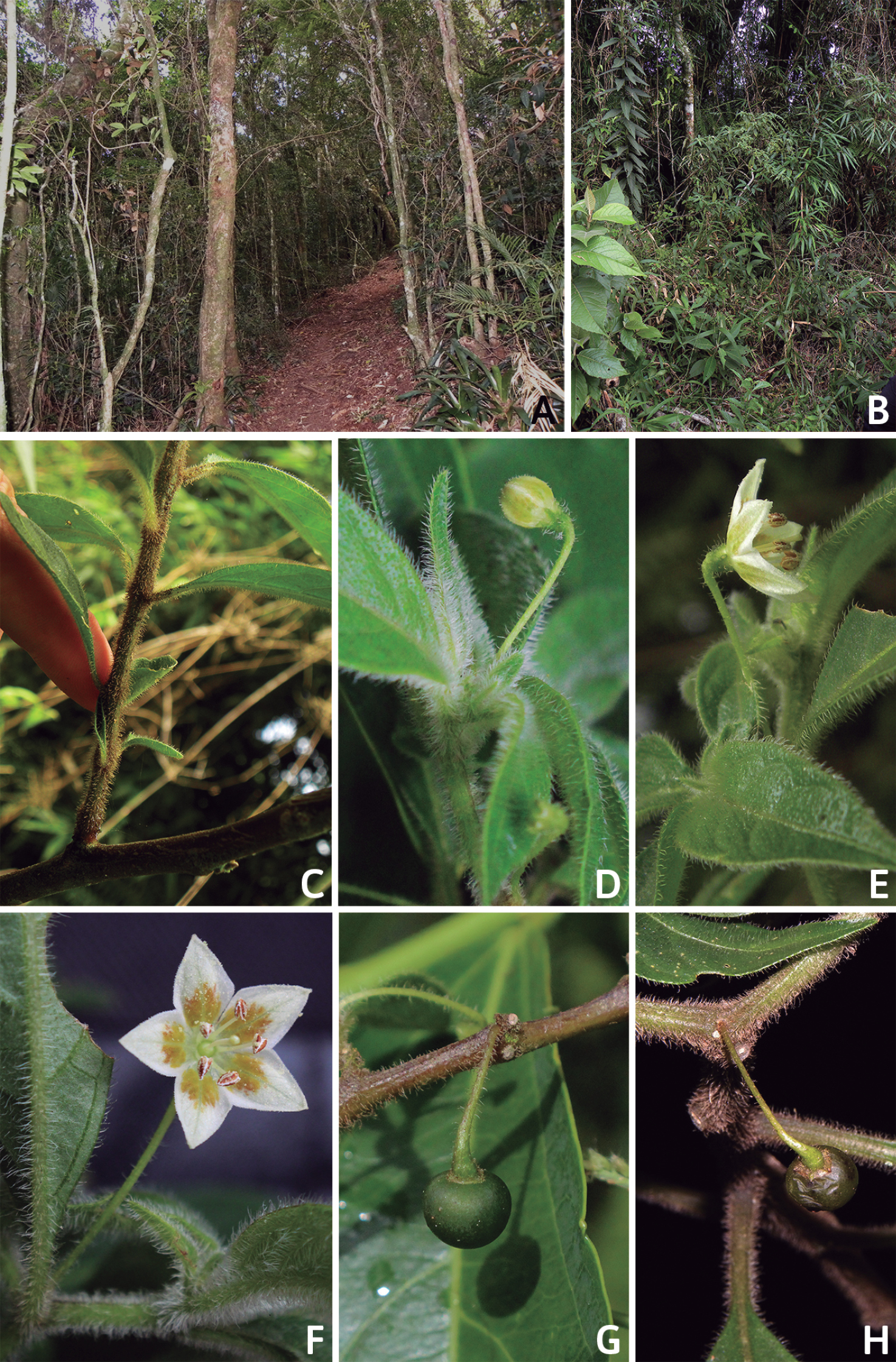
The plant is an upright, much-branched shrub or subshrub, usually 1–2.5 metres tall, with smaller individuals around 80 cm also recorded. Its upper branches repeatedly fork, often creating a noticeable zigzag arrangement. The main stem can be about 1.5 cm thick at the base; young stems are green, slightly angled and relatively fragile, while older wood develops brown or dark-brown bark.
One of the most obvious characteristics is the dense covering of long, spreading hairs. The young stems are covered in pale or occasionally rust-coloured hairs typically 0.5–2 mm long. These are mostly non-glandular, made of several joined cells, and can curve or stand out from the stem. The hairy covering continues over the flower stalks, the bases of the flowers and both faces of the leaves, creating a softly bristled appearance.
Leaves are arranged in unequal pairs, often with one much longer leaf next to a smaller companion. The larger leaves are usually 4.5–11 cm long and about 1.5–3.6 cm wide, narrow elliptical in outline, with a tapered base, pointed tip and smooth edge. Their upper surfaces are dark green with moderately dense hairs; underneath they are lighter green and usually much hairier, especially along the main veins. The main leaf stalks measure about 0.5–1.5 cm, sometimes reaching 2 cm.
The smaller leaves are generally only 2–4.3 cm long and 1–1.4 cm wide, with a short leaf stalk. Because both leaves emerge close together, the branches can look irregular rather than evenly leafy. The contrast between the two leaf sizes, the narrow shape and the persistent surface hairs gives the plant a recognisable appearance even when flowers are not present.
Flowers & the nearly toothless calyx
The flowers form at the leaf joints, usually in groups of two to five, although a single flower is occasionally seen. Their slender stalks can range from approximately 1 to 17 mm long. An especially useful feature is the way the stalk bends sharply near the flower as it opens, a feature botanists call geniculate. Young buds are rounded, swollen and yellowish green.
A fully open flower is approximately 12–14 mm across, with a white, star-like corolla and five broad triangular lobes. The inner surface carries large greenish-yellow markings, usually strongest toward the centre, together with occasional diffuse purple or brown flecks. The flower's central region is cream coloured; its outer surface can also be broadly greenish yellow. The petals are joined through a short tube, giving more substance to the centre of the star.
The five stamens have short white filaments and cream-coloured anthers, which can turn purplish after releasing pollen. The style extends a little beyond the anthers and ends in a pale-green, disc-like stigma. Under magnification, the throat of the flower carries a band of tiny glandular hairs. These details contribute to its botanical identification, but the white-and-green star shape is the easiest feature to see in photographs.
Immediately behind each flower sits the small green calyx, about 2 mm long and wide. It has a thick, five-sided outline and normally bears five extremely short projections, no longer than about 0.2 mm. In some views it appears almost completely toothless. This is one of the clearest differences from Capsicum villosum, whose calyx bears much longer and more obvious narrow projections.
Fruit, seeds & pungency
Its fruit is a small, almost spherical berry, usually only 7–8 mm across. The fruit starts green and develops on a stalk that lengthens to around 20 mm. As the fruiting stalk develops, it bends downward and curves, rather than holding the berry upright. The calyx persists as a small, flattened green disc at its base; its five tiny teeth remain far less visible than the spiky fruit crowns of some other wild peppers.
The 2022 study specifically recorded that the immature green fruits are pungent. This is an important detail because the berries are tiny and because many wild forest peppers from early-diverging lineages are not hot. No numerical Scoville measurement was established for this species in that treatment, so its presence of heat should not be turned into an invented SHU rating.
For fully ripe fruit, the authors described specimens approaching maturity but did not directly confirm the final colour. They suggested that the ripe berries may resemble the greenish-golden-yellow fruit of C. villosum, a related Atlantic Forest pepper. This is a botanical comparison, not a documented observation of a completely ripe C. leptopodum berry.
The mature seeds themselves are striking: a fruit contains usually eight to eleven seeds, sometimes as few as four. They are approximately 3.25–3.75 mm long and 2.5–2.75 mm wide, curved or C-shaped and dark brown-black to black. Under magnification, the seed coat has a network-like pattern with small raised structures near its margins. These dark seeds are a useful reminder that not all members of Capsicum resemble cultivated peppers with pale yellowish seeds.
Native range & forest habitat
The best documented populations are from the central-eastern part of Rio de Janeiro State, southeastern Brazil. The 2022 monograph restricts its verified distribution to this area, including historical references to the Serra d'Estrella, Serra dos Órgãos and Alto da Serra mountains. Kew likewise reports its native range in Rio de Janeiro. USDA GRIN also lists an older São Paulo record under the name C. muticum, a broader database treatment than the focused Rio de Janeiro distribution accepted in the monograph.
The species is associated with Brazil's Mata Atlântica, or Atlantic Forest, a major centre of wild pepper diversity. More specifically, it inhabits montane dense rain forest, known in Brazilian vegetation classifications as Floresta Ombrófila Densa. Specimens were recorded at approximately 1,000–1,300 metres above sea level, where the mountains produce wetter and cooler forest conditions than the coastal lowlands.
Field observations include plants growing in full sun or partial shade, sometimes in disturbed or degraded forest surroundings. This shows that its habitat is not always deep, undisturbed shade. The large forest system is nonetheless important: the plants are scattered in small areas within a mountain landscape already heavily affected by roads, settlement and clearance.
These records describe a very different setting from the drier farms and warm-season beds used for commercial chillies. The combination of montane elevation, steady forest moisture and fragmented native vegetation helps explain both its unusual appearance and why its remaining sites can be difficult to find.
Seasonal life cycle
Herbarium records assembled in the 2022 study show flowering from December through April and fruiting from February through May. These months represent field records from southeastern Brazil, rather than a fixed growing calendar for plants cultivated in other regions.
During flowering, several small blossoms may open around each leaf joint, with young buds appearing on the distinctive sharply bent stalks. As the berries develop, their stalks curve downward, leaving the seeds enclosed in a small, hanging globe. The persistent hairs remain visible on the branches and fruiting structures throughout the cycle.
This is a perennial woody shrub, rather than one of the annual crop peppers commonly grown for a single harvest. The 2022 material includes observations of buds, open flowers, immature berries and fruit near maturity, making it possible to follow the development of the plant through much of the reproductive stage.
Genetics & related species
Modern DNA studies place the plant in the Atlantic Forest clade, a group of closely related wild peppers found mainly in eastern Brazil. Members of this group include Capsicum villosum, C. mirabile, C. schottianum, C. cornutum and C. campylopodium. The relationship matters because this group evolved largely outside the populations from which familiar domesticated peppers arose.
A 2016 genetic study included the plant as Capsicum villosum var. muticum. Its results showed that these plants were genetically closer to C. mirabile than to the typical variety of C. villosum. This supported a long-standing suspicion that the very short-toothed form represented a separate species rather than simply a slight variation of the hairy C. villosum.
In 2022, the authors of the complete genus monograph combined those DNA findings with the original specimens and the distinctive flowers, stalks and calyx to recognise the species as Capsicum muticum. A separate genome-wide study published later in 2022 also placed C. muticum within a well-supported Atlantic Forest evolutionary lineage.
The distinction from crop species is substantial. C. leptopodum shares the same genus as jalapeños, habaneros and rocotos, but its small forest berries, hairy branches and subtly coloured flowers belong to a different evolutionary history. Its scientific value is therefore not limited to any possible food use: it helps reveal the hidden diversity of the pepper genus itself.
How to identify it
The closest obvious lookalike is Capsicum villosum. Both plants can be very hairy, with white flowers and sharply bent flower stalks. The calyx is the best distinguishing feature. In C. leptopodum the five projections are absent or extremely small, no more than 0.2 mm. In typical C. villosum, five well-developed, narrow projections measure about 0.3–2.5 mm.
The flowers provide another useful difference. C. leptopodum has a white flower dominated by greenish-yellow spots toward the centre, with relatively sparse purple-brown flecking. The flowers of C. villosum more often show prominent purple pigmentation on the lobes and around the throat. An identification using both the corolla pattern and calyx is much stronger than one based simply on the dense hairs.
Another relative, Capsicum schottianum, can have greenish-yellow markings in otherwise white flowers, and sometimes very little purple. But C. schottianum is typically much less hairy, with shorter forward-leaning hairs on the stems and foliage. The combination of a thick coat of long spreading hairs, unequal narrow leaves and a near-toothless calyx separates C. leptopodum from that species.
For a confident identification, a flowering branch is more informative than a single loose berry. The original botanists repeatedly returned to flower shape and calyx structure to distinguish these relatives, and those same features remain central in the modern descriptions.
Conservation & rediscovery
The 2022 monograph proposed a preliminary Critically Endangered (CR) assessment under criterion B1ab(iii,iv), based on its very small recorded extent, habitat loss, severe fragmentation and the scarcity of surviving sites. The authors calculated an extent of occurrence of roughly 15.5 km² and an area of occupancy of 16 km² using their distribution data and mapping methods. These measures are technical estimates of range and occupied grid cells, rather than a count of individual pepper plants.
Historical material was collected mostly in the nineteenth and early twentieth centuries, often with only broad mountain locality names. After long gaps in the record, living plants were found again at Alto da Serra in 1986, and subsequent fieldwork recorded them in this same general locality. The researchers described serious disturbance and deforestation there, with the area already fragmented and its habitat continuing to decline.
That Critically Endangered category is the published scientific assessment made by the monograph authors, not a claim of a separately verified official IUCN Red List listing. Kew also displays a different, low-confidence automated extinction-risk prediction labelled “not threatened”; it is a computer prediction, not the same type of detailed, site-based assessment. The documented field evidence and published preliminary assessment therefore deserve to be read separately from that automated estimate.
Protecting the remaining Serra dos Órgãos mountain forest helps conserve both this wild pepper and the larger community of native plants around it. The species is a reminder that a distinctive genetic lineage can survive in small, isolated mountain sites even when it is barely known outside scientific collections.
Sources & photograph credits
This profile uses the Kew-accepted name Capsicum leptopodum and describes the plant using the detailed Capsicum muticum treatment in the 2022 monograph. Historical information is cross-checked against naming records and original-specimen research. The two naming systems are distinguished throughout.
- Barboza, G. E., Carrizo García, C., de Bem Bianchetti, L., Romero, M. V. & Scaldaferro, M. (2022). Monograph of wild and cultivated chili peppers (Capsicum L., Solanaceae). PhytoKeys 200: 1–423. Treatment 31, published as C. muticum, including historical synonyms, detailed morphology, rediscovery, distribution, figures and preliminary Critically Endangered assessment.
- Royal Botanic Gardens, Kew. Capsicum leptopodum (Dunal) Kuntze, Plants of the World Online. Current accepted name, geographical treatment and synonym list; records C. muticum as a synonym.
- International Plant Names Index. Bassovia leptopoda Dunal (1852) and Capsicum leptopodum (Dunal) Kuntze (1891). Primary nomenclatural publication details.
- Barboza, G. E. (2011). Lectotypifications, synonymy, and a new name in Capsicum (Solanoideae, Solanaceae). PhytoKeys 2: 23–38. Selection of Schott 5416 as the lectotype of C. villosum var. muticum, with discussion of lost historical material.
- Carrizo García, C. et al. (2016). Phylogenetic relationships, diversification and expansion of chili peppers (Capsicum, Solanaceae). DNA evidence indicating that var. muticum is distinct from typical C. villosum and belongs to the Atlantic Forest clade.
- Carrizo García, C., Barboza, G. E., Palombo, N. & Weiss-Schneeweiss, H. (2022). Diversification of chiles (Capsicum, Solanaceae) through time and space: New insights from genome-wide RAD-seq data. Frontiers in Genetics 13: 1030536. Modern evidence for the Atlantic Forest evolutionary group.
- USDA Agricultural Research Service. GRIN record: Capsicum muticum and GRIN record: C. leptopodum. Alternative accepted naming treatment and database distribution entries.
- World Flora Online / Solanaceae Source. Capsicum muticum. Independent taxon page reproducing the monograph's ecological, identification and conservation information.
- Photograph credit. Figure 93 in Barboza et al. (2022), photographed by G. E. Barboza from Barboza et al. 5032. Original plate. Published under Creative Commons Attribution 4.0, reproduced without alteration.