Overview
Capsicum longidentatum is a wild pepper native only to Brazil, where it inhabits the seasonally dry Caatinga of Bahia, Pernambuco and northern Minas Gerais. Unlike most familiar garden chillies, it has no detectable heat in its fruit. Its unusual character lies in its long, narrow projections beneath the flowers and berries, rather than in pungency or a large, showy crop.
The plant is an upright or loosely scrambling shrub with delicate paired leaves, pale flowers and branches covered in microscopic forked and tree-like hairs. Its conspicuous calyx appendages may stretch to 8.5 mm — about as long as the little berry itself. The plant is one of the more distinctive members of the pepper genus, both in its appearance and its evolutionary position.
Described in 2011, C. longidentatum was initially compared with other peppers of the Brazilian Caatinga. Later DNA analysis changed that picture: researchers recognised an independent Longidentatum clade, containing this species alone. Its story is a reminder that two wild peppers can share a habitat and several visible traits while having separate evolutionary histories.
- Scientific name
- Capsicum longidentatum Agra & Barboza
- Family
- Solanaceae
- Native range
- Brazil: Bahia, Pernambuco & northern Minas Gerais
- Growth habit
- Erect or scrambling shrub, usually 1.5–4 m
- Scientific description
- 5 August 2011
- Flower colour
- White with greenish-yellow spotting
- Fruit
- Small, round; non-pungent
- Calyx appendages
- Usually five; up to 8.5 mm long
- Habitat
- Caatinga shrubland, rocky slopes & streamside gallery forest
- Elevation
- Approximately 250–900 m
- Chromosomes
- 2n = 24
- Conservation
- Near Threatened (preliminary 2022 assessment)
Discovery & naming
Botanists collected plants now recognised as Capsicum longidentatum before the species was formally named. An older herbarium record, E. Melo 1920, was collected at Itatim, Bahia, on 25 January 1997 and is now listed under this name in the HUEFS collection. The specimen history shows that the plant was present in collections well before its botanical identity was fully resolved.
The name itself is anchored to a later collection made on 8 April 2006 at Morro da Pedra Grande, Itatim, Bahia. E. Melo, F. França, C. T. Lima and C. Cunha gathered specimen 4344 at the base of the granite hill, approximately 285 metres above sea level. The holotype — the official reference specimen for the species name — is held in the HUEFS herbarium under accession 109249.
Brazilian botanist Maria de Fátima Agra and Argentine botanist Gloria E. Barboza introduced the name in a study of Caatinga peppers. Their paper, written with colleagues, was published in Systematic Botany on 5 August 2011. It described C. longidentatum and C. caatingae as new species, and clarified the description of the older C. parvifolium. All three grow in parts of seasonally dry Brazil, but have distinct flowers, calyces, fruits and seed traits.
The name longidentatum means “long-toothed” and refers to the extraordinary slender extensions of the calyx. These had drawn special attention in the first description: their recorded length, reaching 8.5 mm, was unusual enough to become the species' defining feature. That name is especially helpful, because the calyx remains visible around the developing berry long after the flower has dropped.
An earlier Itatim specimen
A herbarium record collected by E. Melo is now identified as C. longidentatum.
Name-bearing collection
Melo and colleagues collect specimen 4344 at Morro da Pedra Grande in Bahia.
Formal scientific description
Agra and Barboza publish C. longidentatum in a study of wild Caatinga peppers.
DNA reveals a separate lineage
A molecular study recognises the species as the sole member of the Longidentatum group.
Revised species account
The major Capsicum monograph updates its distribution and proposes a Near Threatened assessment.
Plant & foliage
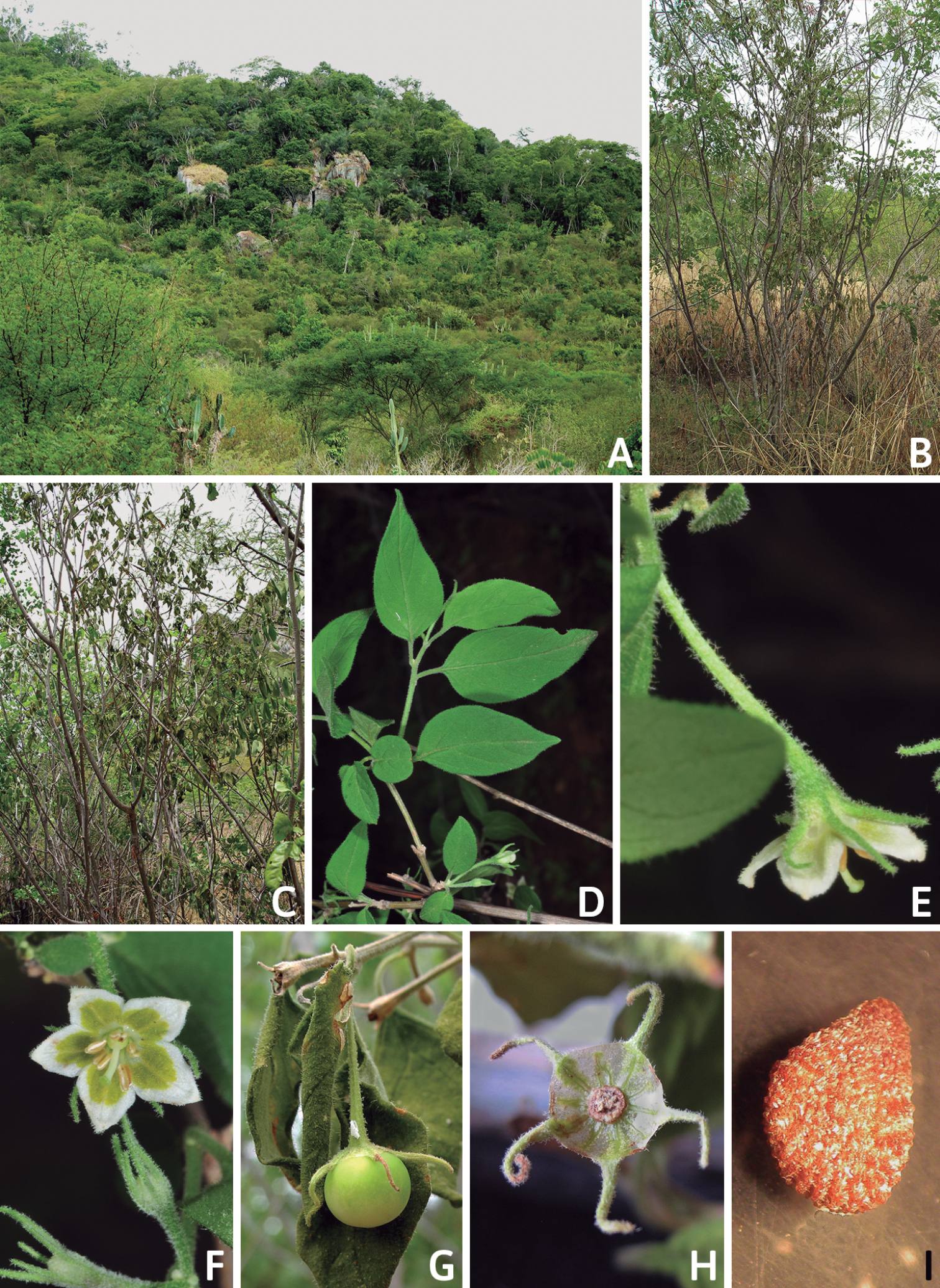
The plant grows as a slender, many-branched shrub, usually around 1.5–4 metres high, sometimes smaller. Its stems are narrow and somewhat fragile, and the longer branches may lean into surrounding vegetation. Younger twigs are angled and greyish to brown, while older stems become smoother and grey. It is not the thick-stemmed, compact bush commonly associated with cultivated peppers.
One of its most important identifying features is its covering of fine hairs. On the youngest stems, leaves and calyces, many of these hairs are forked or repeatedly branched, rather than simple and straight. Botanists call the forked hairs furcate and the little tree-shaped ones dendritic. Individual stem hairs measure roughly 0.2–0.9 mm, but their combined presence creates a noticeably downy texture, especially on fresh young growth.
As with many wild Capsicum species, the leaves often occur as unequal pairs at a branch node. The larger leaf of each pair is typically 3.5–5.4 cm long and 1.5–2.5 cm wide, oval to egg-shaped, with a tapering pointed tip and an entire, unlobed margin. The smaller companion leaf measures about 2.5–3 cm long and 1–1.3 cm wide.
Leaves are thin and soft rather than tough and leathery, with a green upper side and paler, sometimes yellowish-green underside. Both surfaces are hairy, especially beneath along the veins. The main leaves usually show four or five veins on either side of the central vein. This combination of small, paired blades, loose branching and branched leaf hairs separates the plant from numerous other wild peppers.
Flowers & calyx
Flowers grow from the leaf joints, usually in groups of two to five, though an occasional flower is solitary. Their stalks, typically 8–23 mm long, angle downwards and bear spreading, branched hairs. Unlike flowers of many cultivated chillies, the stalk does not form a distinct bend or knee at flowering. The unopened buds are egg-shaped and whitish-green.
The corolla is star-shaped, about 6–7.5 mm long, with five broad triangular lobes split nearly halfway towards the base. It is mainly white, with dark greenish-yellow markings on the inside of the petals and throat. The flower's centre remains pale. Under magnification, tiny gland-tipped hairs can be seen within the corolla, particularly near the base of the lobes; these are among the details used in modern botanical keys.
Five stamens carry cream to light brown anthers about 2–2.5 mm long. The greenish-white style rises slightly above them, by approximately 1 mm. The flowers are fairly small and subtle. Their distinctive structure becomes much easier to recognise when viewed together with the green calyx at the back.
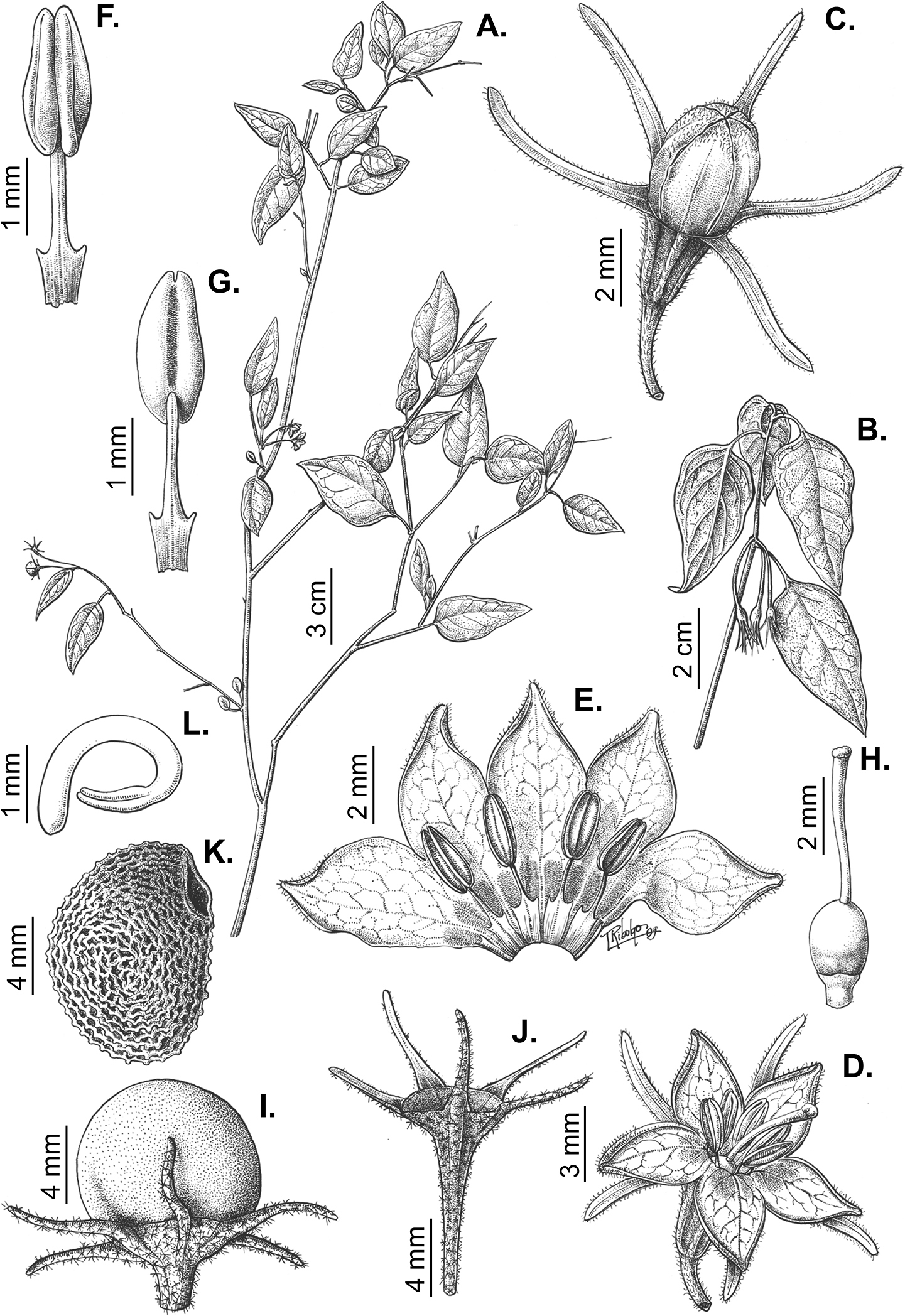
The calyx is the plant's signature feature. Its cup-shaped base is approximately 2–4 mm long, but from its edge extend usually five long, narrow teeth, occasionally six. These projections may measure 5–8.5 mm, with shorter examples around 4.5 mm, and are only around 0.1–0.2 mm wide when flowering. Fine branched hairs cover their surfaces. They are so slender that they can resemble little green needles surrounding the flower.
As the berry forms, the calyx stays attached and the teeth spread outwards around its base, remaining prominent on a fruit barely a centimetre wide. The first scientific description emphasised that these were among the longest calyx teeth known in Capsicum. Another Brazilian species, C. cornutum, can also have projections approaching 8.5 mm, so length alone is not sufficient for identification.
Fruit & seeds
The fruits are almost spherical berries, typically 7.5–9.5 mm long and 7–8.5 mm across. They begin light green and hang on downward-pointing stalks about 15–20 mm long. Their surface is smooth, and the berries separate from the plant as they mature rather than remaining attached indefinitely.
There is a small but important detail in the published colour descriptions. The 2016 DNA study illustrated the species with a greenish-golden-yellow fruit, whereas the detailed 2022 monograph described the exact ripe colour as uncertain and suggested yellowish-green. These descriptions agree that the fruit is pale rather than bright red, but they should not be treated as a confirmed fixed ripening sequence for every wild population.
The berries are non-pungent. The original description also recorded the fruit wall as sweet to taste. These are observations about the botanical specimen, not a reason to treat a rare wild species as an established food crop. Its fruit wall includes enlarged cells studied in pepper anatomy, but lacks the hard internal stone cells present in some other members of the genus.
A typical berry contains around 5–17 seeds, occasionally as few as three. Each seed is relatively large for such a small fruit, about 3–3.7 mm long and 2.5–2.8 mm wide. The seeds are brown to dark brown and are often curved or C-shaped. Under a microscope, their surfaces have an intricate wrinkled or brain-like pattern. The first species description paid particular attention to the thick, pitted seed coat, which adds another useful feature for detailed identification.
One of the most memorable sights is the fruiting calyx itself: a small central green disc with long, radiating teeth, surrounding a rounded berry. With the delicate hanging stalk and dark seeds inside, the whole structure looks very different from the short-calyxed fruits of everyday chillies.
Range & habitat
Capsicum longidentatum is endemic to the Caatinga, the immense seasonally dry landscape of north-eastern Brazil. The species was initially documented from central Bahia and Pernambuco. Later collections included northern Minas Gerais, expanding the recognised range southwards. Kew's current distribution also runs from Pernambuco to northern Minas Gerais.
The Caatinga is not a uniform desert. It includes thorny shrubs, trees that lose their leaves during dry months, rocky hills, open woodland and greener strips alongside streams. This wild pepper has been observed both at the bases of granite outcrops and on rocky slopes with open, shrubby vegetation, as well as in gallery forest close to small rivers. Its appearance as a scrambling shrub makes sense in places where branches may grow through other low vegetation.
The 2022 study records it at roughly 250–900 metres above sea level. Its type locality at Morro da Pedra Grande lies towards the lower end of this range, at about 285 metres. The presence of plants in river corridors and among large granite hills shows that there is more variety to its habitat than the phrase “dry forest” alone suggests.
Botanical collections record flowers from October to April and fruits from November to May. Those dates include the warmer and wetter months in this part of Brazil, when many seasonally dry plants produce new foliage and reproductive growth. These are field observations from the native range, rather than a fixed schedule for a plant raised in another climate.
The species is associated with the Caatinga's native plant communities rather than with commercial chilli fields. That gives it scientific value as part of the wider natural diversity of Capsicum, particularly in an ecosystem that receives less attention than the tropical rainforest yet supports many unique species.
Identification & relatives
When C. longidentatum was named in 2011, the authors compared it with Capsicum caatingae and Capsicum parvifolium, other wild peppers found in the Caatinga. Their similarities explain the historical difficulty of separating collected plants. All are relatively small-flowered forest or woodland peppers, and all can have a loose, shrubby habit.
Yet the differences are considerable. C. caatingae often has larger groups of flowers, a much less pronounced or nearly toothless calyx and flowers with purple colouring. C. parvifolium also differs in its much shorter calyx projections and reproductive structure. Neither shares the same combination of very long calyx teeth, heavily branched hairs, white green-spotted flowers and dark seeds that defines C. longidentatum.
Botanical identification keys also compare it with Capsicum rhomboideum, a widely distributed Andean species with non-pungent fruit and hairy foliage. C. rhomboideum, however, normally has shorter calyx teeth, more flowers in a cluster, yellow rather than white green-spotted corollas, and many smaller seeds per fruit. C. longidentatum typically has fewer than twenty relatively large seeds in each berry.
It can also be distinguished from the Brazilian C. cornutum, whose calyx teeth may be similarly long. The overall combination of flower colour, hanging stalks, leaf hairs and habitat matters more than a single dimension. For a reliable identification, the shape of the calyx, kinds of hairs, floral markings, fruit position and seed characters should be considered together.
Genetics & evolutionary history
Perhaps the most surprising result of studying this plant came from a 2016 DNA-based study of the pepper genus. Early comparisons based largely on appearance had linked C. longidentatum with C. caatingae and C. parvifolium, its geographical neighbours. But the DNA evidence did not support placing all three in one close group.
Instead, C. caatingae and C. parvifolium remained together in the Caatinga clade, while C. longidentatum was recovered as the only representative of a separate lineage, called the Longidentatum clade. Its exact connection to some of the other larger Capsicum groups was not strongly resolved in that study, but its independent position was important enough to be recognised in the comprehensive 2022 monograph.
Chromosome research gives 2n = 24, or twelve pairs. That is the same total chromosome number found in the five domesticated pepper species, though it does not make C. longidentatum a close relative of any particular cultivated chilli. Other wild Capsicum lineages have 26 chromosomes. This distinction helped researchers compare evolutionary histories within the genus.
The 2016 study also discussed its loss of fruit pungency as a derived feature. In other words, its non-hot berries are significant to the evolutionary story, not simply an oddity for pepper growers. Because the species combines unusual flower structures, dry-forest ecology, unusual seed characters, small berries, and a distinct DNA lineage, its value lies in what it reveals about how diverse the pepper genus has become in South America.
Conservation
The scientific assessment of Capsicum longidentatum has changed substantially as researchers documented more sites. In the 2011 description, the authors saw a narrowly distributed plant whose Caatinga habitat was experiencing strong human disturbance, and tentatively assigned Critically Endangered (CR). That assessment reflected the records and field knowledge available at the time.
The 2022 monograph used a broader set of records and proposed Near Threatened (NT) instead. Its authors calculated an extent of occurrence of approximately 275,449 km² but an estimated area of occupancy of just 92 km². The first number describes the broad geographical envelope containing records; the second estimates how much small-scale area is actually occupied in the assessment grid. The contrast shows why a plant may occur across a broad region while still depending on scattered, vulnerable sites.
Despite the newer, less severe category, conservation remains a real concern. The Caatinga has been subject to vegetation clearing, land conversion and fragmentation, while climate-change projections suggest losses of suitable conditions for many of its endemic plants. The monograph's Near Threatened status is a preliminary published assessment; it should not be described as an independently verified official IUCN Red List listing.
Kew's Plants of the World Online separately includes a 2024 model-based prediction placing the species in a broad “threatened” risk category. That automated prediction is not the same as an IUCN category, and it does not replace the researchers' field-based 2022 assessment. The consistent concern across these sources is protecting the remaining natural Caatinga habitats, including rocky outcrops and gallery forests where this distinct wild pepper grows.
Sources & image credits
This page is based chiefly on the original 2011 description, the 2016 molecular study and the detailed 2022 monograph. Naming, type specimen and distribution have been cross-checked against botanical databases. Where older and newer studies differ, their dates and conclusions are kept distinct.
- Barboza, G. E., Agra, M. F., Romero, M. V., Scaldaferro, M. A. & Moscone, E. A. (2011). New Endemic Species of Capsicum (Solanaceae) from the Brazilian Caatinga: Comparison with the Re-circumscribed C. parvifolium. Systematic Botany 36(3): 768–781. Original descriptions of C. longidentatum and C. caatingae, type material, etymology, habitat, and initial conservation view.
- Barboza, G. E., Carrizo García, C., de Bem Bianchetti, L., Romero, M. V. & Scaldaferro, M. (2022). Monograph of wild and cultivated chili peppers (Capsicum L., Solanaceae). PhytoKeys 200: 1–423. Species description, Figures 81–82, distribution, flowering and fruiting periods, chromosome information, phylogenetic placement and preliminary Near Threatened assessment. Open-access full text.
- Carrizo García, C. et al. (2016). Phylogenetic relationships, diversification and expansion of chili peppers (Capsicum, Solanaceae). Annals of Botany 118: 35–51. DNA results establishing the single-species Longidentatum clade and illustrating greenish-golden-yellow fruit (Figure 2A).
- Royal Botanic Gardens, Kew. Plants of the World Online: Capsicum longidentatum. Accepted scientific name, family, and native distribution from Pernambuco to northern Minas Gerais. The site's general information includes a 2024 model-based conservation-risk prediction.
- International Plant Names Index (IPNI). Capsicum longidentatum Agra & Barboza. Publication date of 5 August 2011; holotype collection Melo, França, Lima & Cunha 4344; locality Itatim, Bahia; herbarium HUEFS 109249.
- World Flora Online / Solanaceae Source. Capsicum longidentatum. Reproduces detailed morphology, distribution, flowering and fruiting periods, and the 2022 conservation calculations.
- USDA Agricultural Research Service. GRIN Taxonomy record for Capsicum longidentatum. Confirms accepted name, the three Brazilian states and chromosome number 2n = 24.
- Brazilian herbarium collection data (HUEFS). Record E. Melo 1920 (HUEFS 26326), collected 25 January 1997 in Itatim, Bahia, subsequently identified as Capsicum longidentatum. Collection record context.
- Image credits. The field photo plate (Figure 82) in Barboza et al. (2022) contains photographs by G. E. Barboza and J. R. Stehmann; original figure and caption. The botanical drawing (Figure 81) was drawn by L. Ribulgo, originally published in 2011 and reproduced with permission in the monograph; original figure and caption. The 2022 article is distributed under CC BY 4.0. Both plates are displayed without alteration.