Overview
Capsicum villosum is a wild, perennial shrub in the nightshade family, found naturally in the Atlantic Forest of southeastern Brazil. It belongs to the same genus as jalapeños, habaneros and rocotos, but its appearance is quite different from that of familiar cultivated chillies. The branches spread in a zigzag pattern, the leaves grow in unequal pairs, and much of the plant is covered in conspicuous, spreading hairs.
Its star-shaped flowers are particularly colourful. Seen from the front, the petals are predominantly white, with deep-purple markings and a greenish-yellow star around the centre. Small fruit follow, ripening from green to a translucent greenish-golden yellow. Despite their delicate appearance, the ripe berries are pungent, and hold dark, textured seeds rather than the pale seeds of many cultivated peppers.
The species was formally named by Otto Sendtner in 1846. It remains an accepted species in Kew's Plants of the World Online and the comprehensive Capsicum monograph published in 2022. Botanically, its combination of dense hairs, five calyx projections, patterned flowers, small golden berries and black seeds makes it a useful example of the diversity within the wild Atlantic Forest peppers.
- Scientific name
- Capsicum villosum Sendtn.
- Family
- Solanaceae
- Native country
- Brazil
- First description
- 1846, Flora Brasiliensis 10: 144
- Growth habit
- Hairy shrub, commonly 1–3 m
- Flower
- White, purple-spotted; approx. 14 mm wide
- Mature fruit
- Greenish-golden yellow; 7–9 mm
- Pungency
- Pungent
- Seeds
- 8–15; brownish-black to black
- Chromosomes
- 2n = 26
- Elevation
- Approx. 500–1,900 m
- 2022 conservation
- Preliminary Near Threatened
Discovery & naming
The written scientific history of C. villosum goes back to the nineteenth-century botanical exploration of Brazil. The German botanist Otto Sendtner described it in 1846 in volume 10 of Flora Brasiliensis, the enormous work documenting Brazilian plant life begun under the direction of Carl Friedrich Philipp von Martius. This is the original publication of the species name, not a later transfer from another genus.
The word villosum comes from botanical Latin for shaggy or covered with long soft hairs. In this case the name is especially descriptive: the young stems, flower stalks and undersides of the leaves are often visibly hairy, even without a magnifying glass. The hairs are not merely an incidental feature; the modern identification keys continue to use their density and outward-pointing direction to separate this species from close relatives.
Sendtner also described Capsicum villosum var. latifolium in 1846. The epithet latifolium means broad-leaved, reflecting the way botanists sometimes divided variable plants on leaf shape. Today, Kew treats this variety as a synonym of C. villosum, rather than a separate accepted taxon. The plant has both large and small leaves, and leaf proportions vary, making isolated leaf differences a poor basis for splitting it.
A second historical variety, C. villosum var. muticum, has a different outcome. Although Sendtner published that name in the same 1846 treatment, later studies established that it represents another species. In 2011, Gloria Barboza formally selected a specimen collected by Schott in the Serra da Estrela area of Rio de Janeiro as the reference for the variety. The surviving specimen helped fix the application of the name after one of the original collections from Sellow had been destroyed in Berlin.
In 2022, Barboza and collaborators raised that historically subordinate variety to species rank as Capsicum muticum (Sendtn.) Barboza. Thus the similarly named muticum is not simply another name for the modern C. villosum. This distinction matters when reading older horticultural catalogues, field guides and genetic studies: their identification labels may reflect an earlier classification.
The original description
Otto Sendtner publishes Capsicum villosum and named varieties in Flora Brasiliensis.
Chromosomes documented
A chromosome survey of Brazilian wild peppers confirms 26 chromosomes in plants identified as C. villosum var. villosum.
Historical type fixed
Barboza selects a reference specimen for the old variety muticum, clarifying a long-standing naming problem.
Modern species treatment
The large Capsicum monograph documents morphology, range and conservation and recognises C. muticum as separate.
Plant & stems
In its native habitat, C. villosum usually forms an upright, well-branched shrub or subshrub around 1–3 metres tall. The botanical description includes smaller individuals beginning at approximately 0.8 metres and exceptional specimens reaching 5 metres. As the plant matures, a substantial woody base develops; older trunks may be about 1.5 cm in diameter near the ground. The species can also produce shoots from adventitious roots, contributing to its shrubby form.
Its branching habit is distinctive. After the main stem divides, the branches tend to spread in alternating directions and make a characteristic zigzag outline. Young growth is green and often three-angled rather than perfectly round. The stems are comparatively firm and are covered with long white hairs that stand outward or bend irregularly. On dried specimens, the hairs may look slightly rusty or ochre-coloured.
Older branches become brown to dark brown and develop a finely striped surface. The very dense hairiness of new shoots generally reduces as those shoots age. The contrast between the green, conspicuously hairy young branches and the darker older stems is useful for recognising the species in the field.
These features also show how misleading a single nursery-style photograph can be. A young shoot with large leaves may look like a soft herbaceous chilli, while an older forest plant has a woody, spreading structure and many narrow, crowded branch forks. For a correct identification, the habit, leaves, flowers and developing fruit must be considered together.
Leaves & hairs
The leaves are thin and flexible, a feature botanists describe as membranous. They are normally dark green above and lighter green beneath. At the branch joints they occur in unequal pairs: a larger leaf accompanied by a smaller one. The two can be broadly similar in outline, but the size difference is sometimes dramatic.
The larger leaf blades are normally 6–17 cm long, though the 2022 monograph includes exceptional examples reaching approximately 24.5 cm. Widths are commonly about 2.4–7.5 cm. Their shape ranges from oval to narrowly elliptical, with a tapered base and a long pointed tip. The edges are smooth rather than toothed, and the leaf stalks commonly measure 0.4–2.3 cm, occasionally longer.
The smaller paired leaves may be only 2.2–2.8 cm long, with unusual specimens reaching about 5 cm. These have shorter stalks and fewer prominent side veins. When viewed together, a large, pointed leaf and a small companion create the uneven, paired pattern also found in several other wild Capsicum species.
The species name becomes particularly clear when the foliage is examined closely. Fine white hairs cover both faces of the leaf, but the underside and leaf margins are usually much more densely hairy. The long hairs beneath the leaf may reach about 2 mm, with some standing nearly straight out. On the upper surface, the hairs are often shorter and lie more closely against the leaf. Many are composed of several cells, a structural feature that botanists can see under magnification.
This dense covering separates C. villosum from the much less hairy forms of C. mirabile. It is also useful when its flowers have fallen: the outward-pointing hairs on the stems and flower stalks continue to provide identification clues. Hairiness by itself is not sufficient, however, because several other Atlantic Forest species also develop hairy leaves and stems.
Flowers & calyx
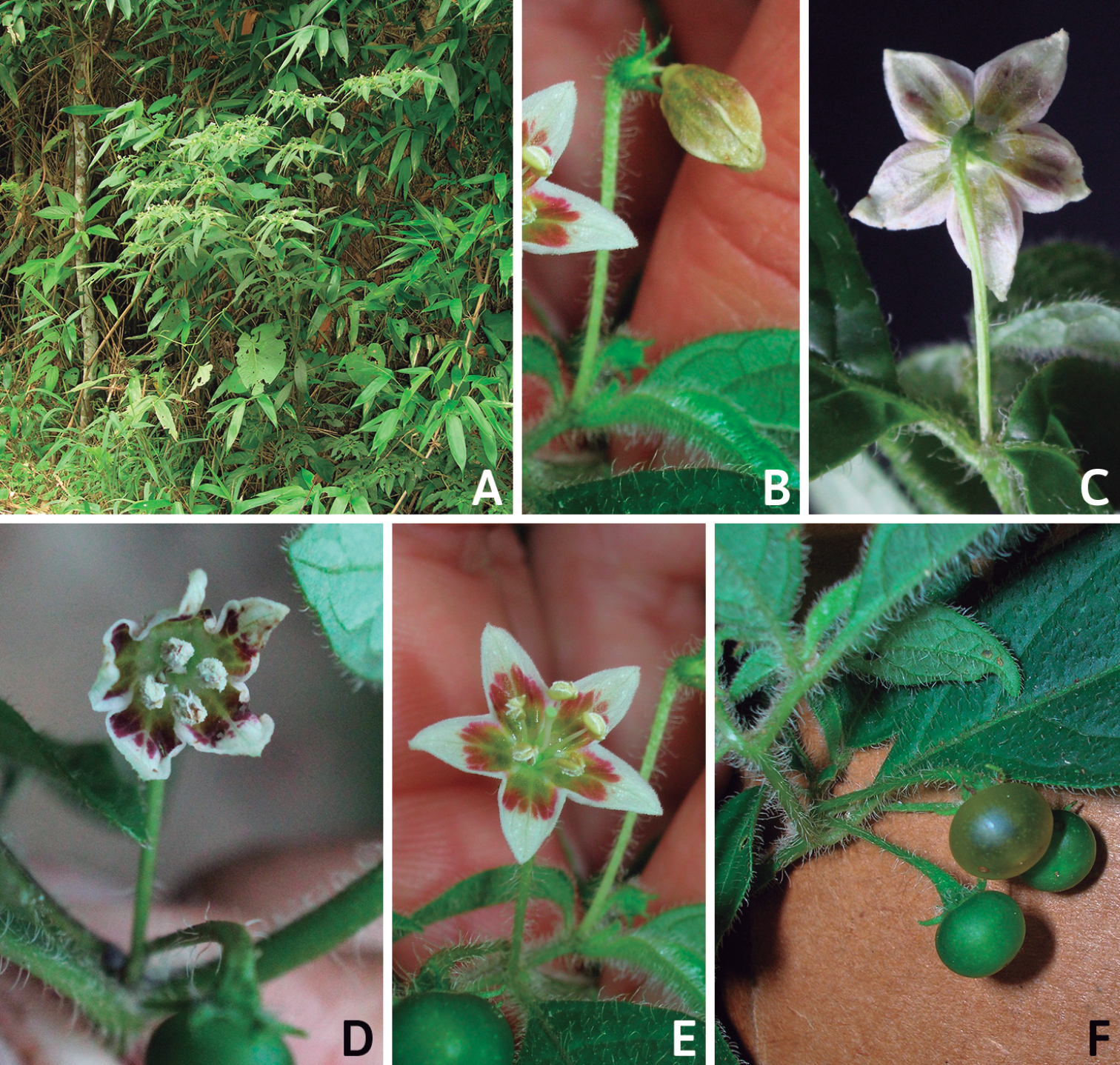
The flowers develop in the leaf axils, usually in groups of three or four, although solitary flowers occasionally occur. Their stalks are commonly 12–17 mm long and may reach about 20 mm. Before opening, the stalk stands relatively upright, but near the flower it bends sharply at a joint. Botanists call this a geniculate pedicel. It gives the developing bud and open flower a distinctive angle.
The unopened buds are rounded or egg-shaped, often yellowish-green with purple patches, or sometimes almost completely purple. Once open, a blossom has five pointed lobes arranged as a star, measuring approximately 14–14.5 mm across and 7–9 mm in length. The petals are white, with a greenish-yellow central star and strong purple or reddish-purple spots across their inner surfaces. Pale purple colouring can also appear on the outside.
The inner flower surface carries a ring of minute glandular hairs around the throat and bases of the petal lobes. These are different from the long simple hairs covering the outside of the plant. At the centre are five stamens with cream or white filaments, typically around 2.4–3.6 mm long, and yellow to cream anthers around 1.5–2 mm long. The style is approximately 3–4.5 mm long, ending in a pale-green, disc-shaped stigma. A small nectary sits at the base of the ovary.
Immediately behind the petals is a thick, green, cup-shaped calyx with five slender projections. On flowers these projections are usually around 1–2 mm long, sometimes reaching 2.5 mm. They are fairly similar in length and are covered in hairs. As a berry forms, the calyx remains in place and its projections spread around the fruit base. Their number is important because other nearby wild peppers can have almost no calyx teeth or as many as ten.
Fruit & seeds
The berries are much smaller than those of common garden peppers. They are nearly spherical, sometimes slightly flattened, and generally 7–9 mm wide. The fruit skin begins green and changes to a luminous greenish-golden yellow at full maturity. In natural light, the ripe fruits can look almost translucent, an unusual appearance beside the opaque red fruits associated with many traditional chilli varieties.
Crucially, the ripe fruit is pungent. The 2022 monograph explicitly describes its heat, while observations of southeastern Brazilian wild peppers have also highlighted pungency in their small berries. A numerical Scoville rating should not be assumed from that botanical description: no single tested value is established by these sources. The fruit's golden colour is therefore not a sign that it is sweet or heatless.
Each ripe berry hangs from an angled fruit stalk, usually 15–24 mm long. The calyx remains attached at the base, creating a little green crown, with its five projections spreading outward. Unlike most commercial chillies, the ripe fruit is deciduous: once mature, it can detach naturally. This is typical of many wild pepper lineages and differs from domesticated types selected to hold their fruits until harvest.
The wall of the berry is relatively thin and translucent, yet its internal anatomy is quite specialised. The researchers describe large cells within the fruit wall and an uneven, alveolate inner surface. The fruit does not contain the hard stone cells found in the walls of some other wild species. These internal traits are visible in the published scientific drawing and help distinguish the berries anatomically, even when colour and size are similar.
A berry typically contains eight to fifteen dark seeds. Each is around 2.4–2.8 mm long, sometimes slightly shorter, and may look elliptical or curved into a C shape. The seed coats are brownish-black to black, with a reticulated network across the main surface and raised, knobbly structures along the edge. Under an electron microscope these marginal structures look like tiny pillars. This patterned dark seed coat is another major difference from the pale, smoother seeds of many domesticated Capsicum.

Range & habitat
Capsicum villosum is endemic to Brazil, with its strongest modern collection record in the southeastern states of Rio de Janeiro, Minas Gerais and São Paulo. The 2022 monograph additionally mentions one collection from Espírito Santo. Some older or differently organised databases list further southern-state records, but the detailed modern species treatment provides the most precise basis for describing its documented core range.
Its natural environment is the Mata Atlântica, or Atlantic Forest, one of South America's richest and most heavily altered forest systems. The species inhabits coastal and inland mountain forests, including moist evergreen forest and several other mountain vegetation formations. The monograph also notes occurrences associated with mixed, river-influenced forest and campo rupestre environments.
Most documented plants grow at approximately 500–1,900 metres above sea level, often in small groups. They may be found along paths close to rivers, streams and waterfalls, on wooded slopes or in forest openings. Some plants stand in shade below the canopy, while others grow where sunlight reaches clearings. The ability to occupy both shaded and relatively open places makes it a little more flexible than species restricted to deep forest interiors.
Water and topography help explain this distribution. Moisture remains relatively accessible along mountain streams, ravines and sheltered valleys even when exposed slopes dry more quickly. The species can appear in regenerated and recovering forest as well as better-preserved habitat. Those conditions are part of the ecology of southeastern Brazil, not proof that it would tolerate any climate or survive without regular moisture in cultivation.
The broader range is important, but it should not be read as a statement that the plant occurs everywhere between its most distant collection sites. Wild pepper populations can be sparse and local, and its recorded presence in small colonies gives a more accurate sense of how it is encountered on the ground.
Ecology & life cycle
The scientific collections used for the 2022 monograph document flowering mainly from October to April, while fruits were recorded from late December to July. These months describe the seasons in southeastern Brazil. They are observations of wild populations, not a fixed calendar that can be applied to plants grown elsewhere in the world.
The species is a perennial, not a short-lived crop plant grown for a single annual harvest. Its woody lower stems can persist while new hairy branches emerge above them. Flowering often occurs at the newer branch joints, where several buds may develop together. The ability to produce shoots from adventitious roots also helps explain why plants can form small shrubby groups in favourable places.
The colourful flowers have a typical five-parted Capsicum structure, with exposed pollen-bearing anthers and a nectar-producing region within the flower. The bright purple patterns likely influence how the flower appears to visitors, but specific pollinator partnerships for this species should not be claimed without field observations. The same caution applies to fruit dispersal: the berries are colourful, fleshy and detach when ripe, traits broadly associated with animal dispersal in wild peppers, but the identity of dispersing animals for C. villosum is not established by the species description.
The name pimentinha is recorded on a São Paulo herbarium specimen, Kirizawa 3288. In Portuguese this broadly means “little pepper”. It is a useful historical local name, but not evidence of a widespread commercial crop or a particular regional recipe. C. villosum is primarily documented as a wild forest plant, not as one of Brazil's mainstream cultivated pepper species.
Its seeds are occasionally of interest to specialist wild-pepper growers, but the species' scientific significance is greater than its horticultural footprint. The unusual flower colour, hairy foliage, black seed coats and 26-chromosome complement make living material valuable for studying diversity in the genus.
How to recognise it
The most helpful starting clue is the heavy covering of outward-pointing hairs, particularly on green stems, flower stalks and the leaf undersides. Many peppers have some hairs, but the prominence of these longer, spreading hairs is one of the identifying characters of C. villosum. The leaves themselves tend to be thin, unequally paired and long-pointed.
When the plant is flowering, look for three to four blooms at the leaf joints, sharply angled flower stalks, a white star-shaped corolla with strong purple markings inside, and a green calyx bearing five similar-sized slender projections. The greenish-yellow star around the throat contrasts with both the dark purple spots and the paler outer petal areas.
When fruiting, the small green-to-golden berries, drooping angled stalks, five persistent calyx teeth and hard-looking dark seeds support the identification. Size and fruit colour alone are not enough: several wild Atlantic Forest peppers produce similarly small golden-green fruit. A useful identification therefore combines several features across different stages of growth.
The 2022 identification key particularly emphasises the direction of the stem hairs. In C. villosum these generally spread outward; in some similar plants they lie forward against the stem. This distinction can be subtle in photographs, but becomes clearer under a hand lens or when examining a living specimen from several angles.
Related species & old names
Modern DNA research places Capsicum villosum within the Atlantic Forest clade, a group of wild Brazilian peppers distinct from the main domesticated C. annuum, C. chinense and C. baccatum branches. This group includes species such as C. mirabile, C. schottianum, C. cornutum and C. pereirae. Some members share golden berries and black seeds while differing in flower patterns, hairs and calyx shape.
Compared with Capsicum mirabile
C. mirabile may also have purple-marked white flowers and five calyx projections. However, it is typically almost hairless or only sparsely hairy, whereas C. villosum is densely covered in long, spreading hairs. Their flower colouring can vary, so the leaves and stems are often the more dependable difference.
Compared with Capsicum rabenii
C. rabenii is another visibly hairy species with a five-parted calyx and patterned flowers. Its corolla, however, is chiefly purple or lilac around the margins, with a greenish-yellow centre, rather than having the strongly contrasting purple spots inside the largely white petals typical of C. villosum. The two also belong to different evolutionary groups.
Compared with Capsicum cornutum and Capsicum schottianum
C. cornutum tends to have a more elaborate calyx with up to ten, often longer projections and larger flowers. C. schottianum commonly has no obvious calyx teeth, or only minute ones; its flower markings vary considerably. These features matter especially in collections where several species look broadly alike from a distance.
Why Capsicum muticum is a separate species
The old name Capsicum villosum var. muticum can create a misleading impression that muticum is still simply a form of villosum. The 2022 taxonomic treatment recognises Capsicum muticum as a separate species. Kew, which accepts the older name Capsicum leptopodum for that plant, follows a different naming treatment. Both approaches distinguish it from the present species. Likewise, the old var. latifolium is treated as a synonym of C. villosum by Kew, not an independently accepted species.
Chromosomes & genetic research
C. villosum has 26 chromosomes (2n = 2x = 26), unlike most familiar domesticated chillies, which have 24. A peer-reviewed chromosome study published in 2006 reported that count for plants then labelled C. villosum var. villosum. The finding was later incorporated into larger studies of the genus and its relationships.
Those extra chromosomes are not evidence that the plant is a hybrid or has doubled its entire genome. It is a diploid species with a base chromosome number of x = 13, whereas many other Capsicum lineages have x = 12. This difference helps botanists investigate how chromosome numbers evolved within wild peppers. It does not by itself determine fruit heat, size or compatibility with cultivated species.
The large DNA-based study published by Carrizo García and colleagues in 2016 helped resolve the evolutionary groups of Capsicum and highlighted the distinct Atlantic Forest branch. The 2022 monograph combined genetic findings with specimens and field observations to establish a fuller picture of how C. villosum relates to other native Brazilian species.
These lines of research explain why the species is worth studying even though its fruits are tiny. Its chromosome complement, distinctive seed coat, dense hair covering and coloured flowers represent variations that have largely been lost or overlooked in peppers selected for agriculture. Understanding these traits contributes to the wider history of how the chilli genus diversified in South America.
Conservation
The authors of the 2022 Capsicum monograph proposed a preliminary Near Threatened (NT) conservation category for C. villosum. Their geographic calculations gave an extent of occurrence of approximately 216,703 km² and an area of occupancy of 172 km². These are different measures: the first describes the broad space across known sites, while the second estimates the much smaller area in which plants are actually recorded.
The researchers observed that the species is relatively widespread within the Atlantic Forest and occurs in protected areas and recovering woodland. At the same time, its forest habitat faces continuing pressure from illegal extraction, clearing and changes in land use. Those risks are serious for a plant that often grows in small local groups, even when its known records are spread across several Brazilian states.
The Near Threatened category is the researchers' published preliminary assessment, not a claim of a separately confirmed IUCN Red List listing. Kew also shows a 2024 automated extinction-risk prediction of “not threatened”, but labels the prediction low confidence. A low-confidence automated prediction is not equivalent to the 2022 authors' specimen-based conservation assessment, and it should not replace it.
Conserving the species depends primarily on the survival of humid Atlantic Forest habitats, especially the mountain streamsides and forest clearings where it has been collected. Protecting these environments also preserves the other wild pepper species sharing them, along with their distinct flowers, seeds and genetic traits.
Sources & image credits
This profile is based mainly on the comprehensive 2022 botanical species treatment, checked against Kew, taxonomic records, historical naming work and chromosome research. The two illustrated plates are attributed to their original authors.
- Barboza, G. E., Carrizo García, C., de Bem Bianchetti, L., Romero, M. V. & Scaldaferro, M. (2022). Monograph of wild and cultivated chili peppers (Capsicum L., Solanaceae). PhytoKeys 200: 1–423. The detailed treatment of C. villosum, including morphology, original naming, figures 119–121, distribution, ecology, seeds and Near Threatened assessment. Read the monograph.
- Royal Botanic Gardens, Kew. Plants of the World Online: Capsicum villosum Sendtn. Accepted name, original publication, southeast Brazilian range and synonym C. villosum var. latifolium. View Kew record.
- World Flora Online / Solanaceae Source. Capsicum villosum botanical treatment reproducing the detailed morphology, measurements, distribution, phenology and conservation text. View species treatment.
- Barboza, G. E. (2011). Lectotypifications, synonymy, and a new name in Capsicum (Solanoideae, Solanaceae). PhytoKeys 2: 23–38. Fixes the reference specimen for the old variety muticum, documenting its original collectors. Read publication.
- International Plant Names Index. The original 1846 name C. villosum and the historical variety C. villosum var. muticum, subsequently combined as C. muticum in 2022. Species record · Variety record.
- Pozzobon, M. T., Schifino-Wittmann, M. T. & Bianchetti, L. de B. (2006). Chromosome numbers in wild and semidomesticated Brazilian Capsicum L. (Solanaceae) species: do x = 12 and x = 13 represent two evolutionary lines? Botanical Journal of the Linnean Society 151: 259–269. Documents 26 chromosomes in C. villosum var. villosum. View study.
- Carrizo García, C. et al. (2016). Phylogenetic relationships, diversification and expansion of chili peppers (Capsicum, Solanaceae). Annals of Botany 118: 35–51. DNA evidence for the major wild-pepper lineages, including the Atlantic Forest group. View research.
- USDA Agricultural Research Service, GRIN Taxonomy. Record for Capsicum villosum (taxon 412490), its original description and published chromosome and distribution references. View record.
- Field Museum / Southeast Brazilian Wild Capsicum guide. Photographic field comparison of hairy wild peppers, flower markings and calyx teeth; some older species names in the guide reflect the taxonomy used at that time. View guide.
- Bachman, S. P. et al. (2024). Extinction risk predictions for the world's flowering plants to support their conservation. Automated prediction shown by Kew for C. villosum, explicitly identified as low confidence; not a replacement for a species-specific Red List assessment. View research.
- Scientific figures & credits. Figure 121, photographed by G. E. Barboza and R. Deanna. Figure 120, illustrated by L. Sánchez, modified from Hunziker (1971) with permission. Both published in Barboza et al. (2022) under CC BY 4.0 and displayed without alteration. Original drawing · Original photographs.